[pageLogInLogOut]

#ITMA 2019

Textechno celebrates its 70th birthday at ITMA Barcelona
(c) 2019 Textechno
Founded in April 1949, Textechno Herbert Stein GmbH & Co. KG, Germany, looks back at 70 years of innovation in textile testing. Today, the Textechno Group consists of Textechno and its Austrian subsidiary Lenzing Instruments and is world market- and technology leader in the field of testing equipment for man-made fibres and yarns.

At ITMA 2019 in Barcelona, Textechno will exhibit its well-proven STATIMAT series – the most complete series of automatic tensile testers for yarns world-wide, ranging from the finest Spandex (STATIMAT MEL+) to the coarsest and strongest Aramids and UHMWPEs (STATIMAT 4U).

The world standard equipment for static crimp and shrinkage tests, TEXTURMAT ME+, as well as its dynamic counterpart, DYNAFIL ME+, will be shown in Barcelona. Moreover, the fully-automatic evenness tester COVAMAT, which was shown as a prototype at ITMA 2015, is now in series production and fulfils all requirements of an effective and reliable quality control on POY, FDY, and IDY.

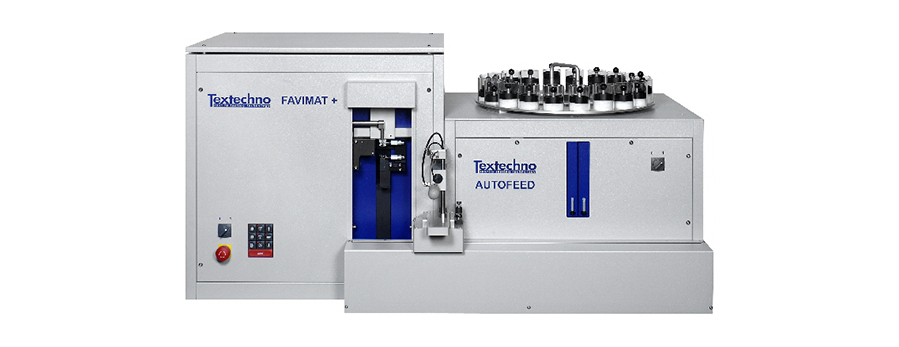
Textechno has developed the world’s first single-fibre tensile testers in the early 50ies. By now Textechno offers the sixth generation of single fibre testing instruments and combines it with the highest degree of automation. FAVIMAT+ AUTOFEED fetches single fibres from the floc and measures linear density, tensile, and crimp properties including crimp number.
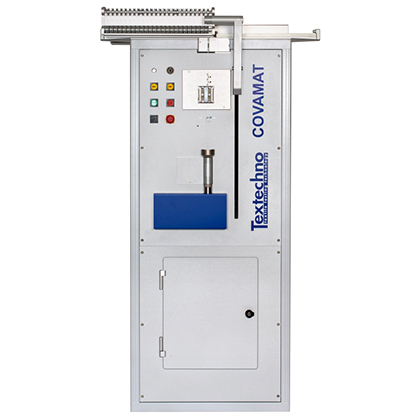
Covamat (c) 2019 Textechno


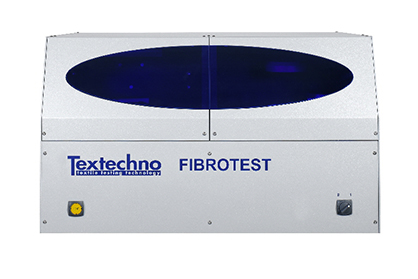
Fibrotest (c) 2019 Textechno


Since FAVIMAT+ is suitable for all kinds of fibres, it has also successfully entered the market of reinforcement fibres such as glass- or Carbon fibres. The award winning FIMATEST system measures fibre/matrix-adhesion and now also the contact angle and is a great addition to Textechno’s FAVIMAT+ in the field of composite testing.

At ITMA 2007 Textechno has started a range of instruments for natural fibres and spun yarns, which is now complete: Textechno's Fibre Classifying System FCS and MDTA 4 determine the quality and spinnability of both cotton- and synthetic fibres. At this ITMA the focus will be on the enhanced fibre bundle length and strength tester FIBROTEST, the new micronaire tester FIBROFLOW, the new trash and colour tester OPTOTEST, as well as the fibre length-, impurity- and spinnability tester MDTA 4.

Visit the joint booth of the Textechno Group – Textechno and Lenzing Instruments: Hall UL (Under linkway), booth C105.



More News from TEXTECHNO Herbert Stein GmbH & Co. KG

More News on ITMA 2019

Latest News

#Heimtextil 2027

Heimtextil celebrates Milan Design Week honoring partnerships with Patricia Urquiola and Alcova Milano

Heimtextil is represented at Milan Design Week with its strong design partners Patricia Urquiola and Alcova. At Villa Pestarini, the leading trade fair spotlighted its dynamic collaborations with acclaimed designer Patricia Urquiola and Alcova Milano.

#Texprocess 2026

Kornit Digital expands digital production into footwear and technical textiles with Presto MAX PLUS

Kornit Digital (NASDAQ: KRNT) (“Kornit” or the “Company”), a global pioneer in sustainable, on-demand digital fashion and textile production, today unveiled the Kornit Presto MAX PLUS, a new roll-to-roll system expanding digital manufacturing into footwear, automotive interiors, military camouflage, high-performance sportswear, and high-end furnishings. Debuting at Texprocess 2026 in Frankfurt, Presto MAX PLUS enables entirely new applications for on-demand textile production.

#Textile processing

NATULON® zipper series surpasses 50% of YKK’s global zipper sales

YKK Corporation (Headquarters: Chiyoda-ku, Tokyo; President: Koichi Matsushima; hereafter, YKK) announces that the global sales share of its NATULON® zipper series—zippers that incorporate recycled materials—has exceeded 50%.

#Smart Textiles

Covestro, FILK Freiberg, and OUT e.V. develop flexible, conductive polymer smart textile system

As the smart textiles market continues to grow across healthcare, personal protection, sportswear, and automotive applications, developers are seeking new ways to integrate electronic functionality directly into textiles, without the rigidity and complexity of conventional wiring. To address this challenge, FILK Freiberg Institute, an independent research institution with expertise in polymer coatings for textile applications, collaborated with Optotransmitter-Umweltschutz-Technologie (OUT) e.V. The joint project, funded under the German Industrielle Gemeinschaftsforschung (IGF) program of the Bundesministerium für Wirtschaft und Energie (BMWE), focused on developing flexible, conductive polymer surfaces for next-generation smart textiles.

TOP
