[pageLogInLogOut]

#ITMA 2015

Textechno with brand-new testing instruments at the ITMA

At the ITMA 2015 in Milano, Italy, TEXTECHNO Herbert Stein GmbH & Co. KG and their subsidiary company LENZING INSTRUMENTS (Austria) will present a number of brand-new testing instruments for fibres, yarns, and fabrics.
To Textechno's 'Cotton Control Line' several innovative instruments have been added including the MDTA 4 microdust-, neps-, trash-, and fibre-length tester as well as the automatic capacitiveevenness-and count tester for slivers and rovings COVASLIVE.

STATIMAT DS together with COVASLIVE offer the combination of the most essential test methods for slivers, rovings, and yarns - tensile properties, evenness and count – with a high degree of efficiency and flexibility.

In the field of automatic single-fibre testing FAVIMAT+ is now featuring more test methods incorporated in the equipment. A new sample feed unit - AUTOFEED – reduces labour for preparation of the test specimen and introduction into the test field to literally zero.
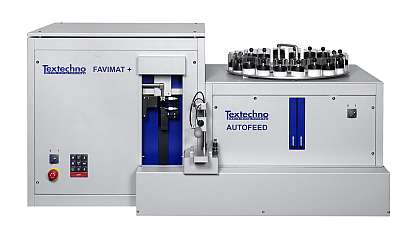
Pic: TexTechno Favimat with Autofeed

Textechno's new automatic capacitive evenness tester for filament yarn COVAMAT with its novel sensor design, automatic package changer and a high-speed yarn twister fulfills all requirements on an effective and reliable quality control system.

The concept to operate the universal filament yarn tester DYNAFIL ME+ either as a stand-alone unit or in combination with the capacitive evenness tester COVAFIL+ and the count tester COMCOUNT provides - apart from tensile strength and elongation - all relevant yarn parameters in one test system only.

For determining the number of interlaces Textechno has developed the new Interlace and Interlace Stability Tester ITEMAT+ TSI as the successor of the well-known ITEMAT by Enka tecnica after taking over all rights on this instrument. While the basic principle was kept the same, drives and electronics have been replaced by state-of-the-art technology and the mechanical interlace sensor has been completely re-designed to serve a larger linear-density range at better reproducibility.

Another highlight is the automatic drapability tester DRAPETEST for technical- and non-crimp fabrics.

This instrument allows to automatically characterize drapability and to detect defects during draping and forming. The tester combines the measurement of the force, which is arising due to forming, with an optical analysis of small-scale defects such as gaps and undulation by means of image analysis. A further optional sensor can determine large-scale defects such as wrinkles.

Joint booth of the Textechno Group – Textechno and Lenzing Instruments: Hall 2, booth E104
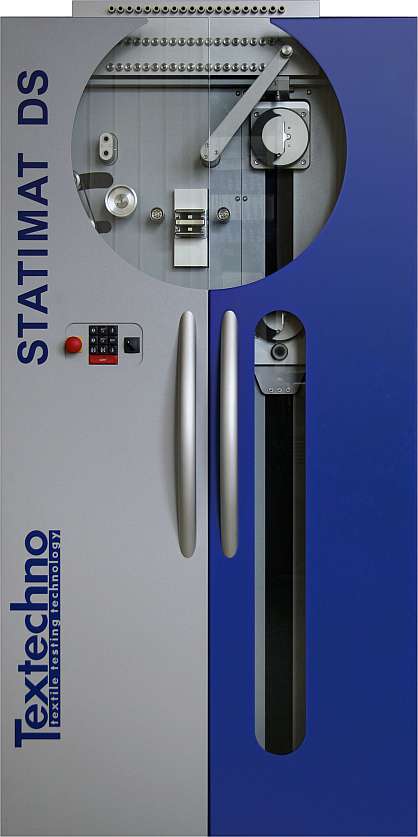
Pic: TexTechno StatimatDS

More News from TEXTECHNO Herbert Stein GmbH & Co. KG

More News on ITMA 2015

Latest News

#Sustainability

Ying McGuire becomes new CEO of Cascale

Cascale today announced the appointment of Ying McGuire as Chief Executive Officer, effective June 1, 2026.

#Technical Textiles

Sustainable, lightweight, and sound absorbing: Polyester-based front trunk solution for BEVs

As car manufacturers look to further reduce their carbon footprint, Autoneum has developed an innovative front trunk solution for battery electric vehicles (BEVs), made entirely from polyester-based textile. The Ultra-Silent Frunk offers significant weight reduction, improved acoustic and thermal insulation, and uses up to 70 percent recycled material, supporting sustainable and efficient vehicle design. Autoneum, global technology leader in acoustic and thermal management for vehicles, has already received orders for the new frunk from three major OEMs in Asia and Europe to be built in three BEV models. Series production for two BEVs has been underway in China and Germany since last year.

#Raw Materials

Modern testing methods for raw cotton

The 38th International Cotton Conference Bremen will take place from 25 to 27 March 2026 at the Bremen Parliament. This conference has traditionally stood for in-depth expertise and international exchange. The program will focus on technical innovations, market trends, and regulatory frameworks across the entire value chain – from agriculture to the circular economy. With high-profile speakers, the conference is regarded as the key meeting point for the global cotton industry. Today’s focus: Cotton quality and testing methods.

#Spinning

Rieter responds to higher raw material prices

Global political and economic developments have been leading to rising raw material and energy costs for some time. The textile machinery industry is also affected by this trend. Rieter machines and components consist to a large extent of steel, copper, aluminum and electronics. These materials in particular have seen higher demand and higher prices in recent months.

TOP



