[pageLogInLogOut]

#Embroidery

Textile revolution on the dress of the Nobel peace prize winner
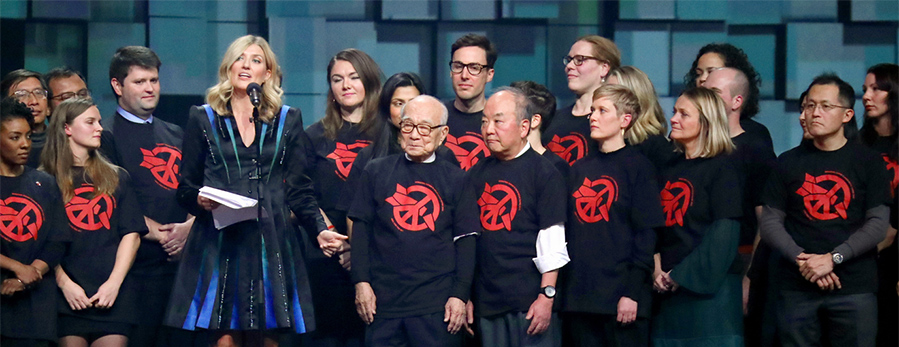
Beatrice Fihn © Cision
When Beatrice Fihn, Executive Director of ICAN, the Nobel peace prize winner 2017, attended the Nobel Peace Prize Concert in Oslo, she did it in a dress designed by Bahareh Ardakani with the brand Artésir. The dress is made of the finest materials, decorated with luxurious mountain crystals and Embroline embroideries, from the innovative company Coloreel.

These unique embroideries are made with more than half a million stitches of 4000 meter Embroline thread softly changing colour from green to blue. With this dress Beatrice is the first person in the world to carry Embroline embroideries in public, apart from embroideries shown by Coloreel at events, fairs and catwalks. 

The founder of Coloreel, Joakim Staberg, says: “It has been a great honour for us to be able to contribute with our thread colouring technology to a dress worn at such a prominent occasion”. 

The Coloreel technology enables a high-quality instant colouring of textile thread while the thread is being used in textile production. The first product to be launched based on this technology is Embroline, a groundbreaking thread colouring attachment that can be used with any existing embroidery machine. By instantly colouring a white base thread during the embroidery production, Embroline enables complete freedom to create unique embroideries without any limitations in the use of colours.

Colour changes along the thread can be made rapidly from one solid colour to another or gradually, to make smooth transitions or any colouring effect you can imagine.
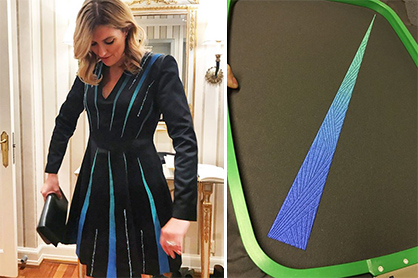
Beatrice Fihn / Embroline Embrodery by Coloreel © Cision


Bahareh says “Embroline opens up entirely new ways of creating embroideries that have not been possible before. The embroideries on Beatrice’s dress is a great example of this. Embroline is definitely the future of embroidery”. 

Beatrice agrees and adds “I also really cherish the environmental benefits that comes along with this innovative thread colouring technology”.

More News from Coloreel

More News on Embroidery

Latest News

#Textile chemistry

A flagship for chemical production: BASF inaugurates world-scale Verbund site in China

BASF today (March 26, 2026) celebrated the official inauguration of its newly built, world-scale Verbund site in Zhanjiang, Guangdong Province in southern China. Covering an area of around four square kilometers, it is more than a major BASF project in the chemical growth market of China. “Zhanjiang shows what the future of chemistry looks like: efficient, digital and sustainable by design. The site showcases a smart integrated Verbund structure on an industrial scale,” said Dr. Markus Kamieth, CEO of BASF, at the ceremony attended by representatives from government, customers, business partners and employees.

#Nonwovens

VEOCEL™ Lyocell production expands to Asia – Launching a new chapter for nonwovens in the region

VEOCEL™, Lenzing's flagship specialty nonwovens brand, expands production at its Thai plant in Prachinburi. This is the first-ever production of its nonwoven-grade lyocell fibers in Asia. Built in 2022 with a 100,000-ton annual production capacity, the facility - previously focused on fibers for textile applications - now can directly meet the demand for VEOCEL™’s biodegradable¹, wood-based lyocell fibers for nonwovens products. These fibers are an essential ingredient for high-quality nonwovens products, ranging from baby wipes to facial sheet masks and everyday personal hygiene items.

#Research & Development

Hof University develops sustainable textile coating for the fashion of tomorrow from mushrooms

Clothing is often treated as disposable: T-shirts for events, general merchandise, or short-term campaigns frequently end up in the trash after only a few uses. This is particularly problematic given that their production still largely relies on fossil-based materials. This is precisely where a new research project at Hof University of Applied Sciences comes in.

#Raw Materials

Fashion for Good mobilises industry to adopt mass balance attribution and accelerate decarbonisation

Fashion for Good launches today the Mass Balance Demonstrator project, a collaborative industry initiative to implement and scale the mass balance attribution (MBA) chain-of-custody model for biomass-attributed PET in textile applications. The project represents a concrete step toward accelerating brand-driven decarbonisation across the apparel value chain.

TOP