[pageLogInLogOut]

#Dyeing, Drying, Finishing

How to do more with less explored at Kingpins24 Flash
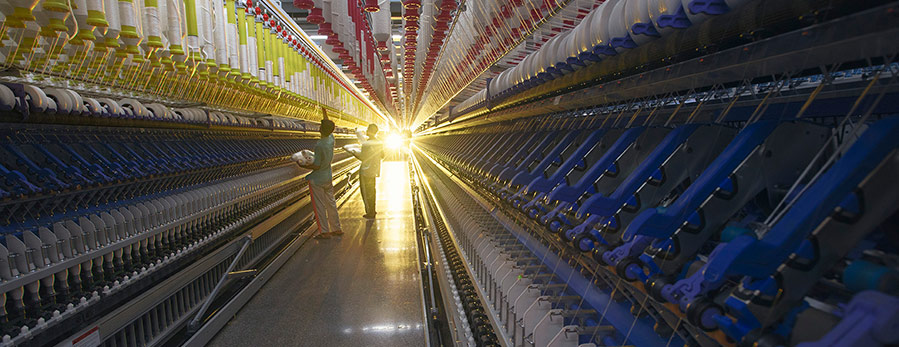
Spinning operation at Artistic Milliners in Karachi, where the new 70,000 square-foot Circular Park for recycling yarn and fabric waste is being planned. Image courtesy of Artistic Milliners. © 2021 Monforts
Recycling their cotton waste has become one way these companies can do more with less, and at the recent Kingpins24 Flash online event, Sedef Uncu Aki, director of Orta, headquartered in Istanbul, Turkey, announced a new partnership with leading recycling operation Gama Recycle.

Major Monforts denim customers continue to pioneer new initiatives that are pushing the boundaries of sustainable production.

Traceable

“Through this local partnership we will supply the waste from our spinning mills and return around 3,000 tons of premium quality cotton back to them,” she said. “We have established a truly controlled and traceable system and partnering with a domestic recycling centre is important because a lot the carbon emissions associated with recycling usually come from transportation.”

Orta’s ZeroMax range meanwhile uses no cotton at all, being based on Lenzing’s Tencel cellulosic fibre, while the company’s involvement in denim production for a recent launch by Levi Strauss, of jeans made with organic cotton and Circulose – a breakthrough material developed by re:newcell of Sweden and partners – was hailed as a further step forward.

To make Circulose, re:newcell repurposes discarded cotton textiles, such as worn-out denim jeans, through a process akin to recycling paper. The incoming waste fabrics are broken down using water. The colour is then stripped from these materials using an eco-friendly bleach and after any synthetic fibres are removed from the mix, the slurry-like mixture is dried and the excess water is extracted, leaving behind a sheet of Circulose. This sheet is then made into viscose fibre which is combined with cotton and woven into new fabrics.
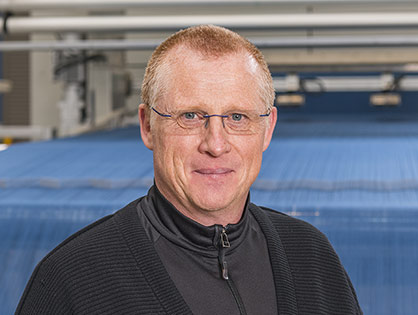
Monforts Head of Denim Hans Wroblowski. © 2021 Monforts


Circular Park

Omer Ahmed, CEO of Artistic Milliners also announced plans for his company’s new 70,000 square-foot Circular Park in Karachi, Pakistan, at Kingpins24 Flash.

Once complete, this will add three million square metres of additional denim capacity a month to the company’s production and take its total recycled output to a monthly five million metres.

Ahmed observed that there is currently a lack of sustainable fibres that are readily available to use for denim production at scale.

“Organic cotton is too expensive, and in my opinion always will be,” he said. “Cottonised hemp is also not cheap and it’s hard to mix with cotton, while the new regenerated cellulose fibres that are now emerging are promising, but currently in short supply. Recycled polyester is meanwhile still based on petroleum resources which we want to move away from. As a consequence, there are only a few other options for us as a manufacturer and this new project will help us minimise our own waste while significantly lowering our carbon footprint.”
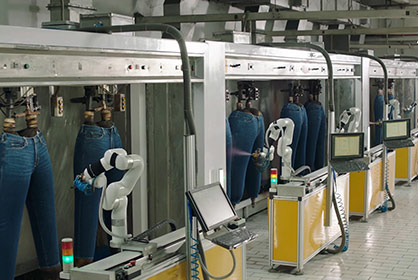
Proprietary robotics for garment finishing at AGI Denim. © 2021 Monforts


Other Monforts denim customers to introduce cotton fibre recycling operations at their plants recently include AGI Denim, Bossa and Soorty.

Vertical savings

Refresh is the name of the latest collection from AGI Denim – reflecting the company’s significant reduction in water consumption. 

Refresh is the name of the latest collection from AGI Denim – reflecting the company’s significant reduction in water consumption.

The company has just opened new fibre spinning and denim mills at its complex in Karachi, Pakistan.
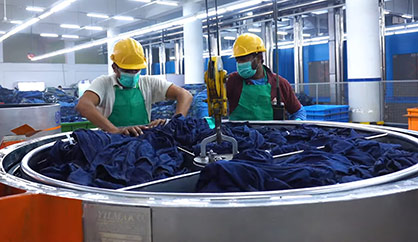
AGI Denim now recycles 4.4 million gallons of water each month as a result of its new wastewater treatment plant. © 2021 Monforts


“Over the years we’ve gone through a series of backward integration steps to become fully vertical,” said AGI Denim executive director Ahmed Javed, at Kingpins24 Flash. “In our latest expansion, we revisited every step of the production processes in order to make resource savings.”

Innovations have included the installation of proprietary robotics for garment finishing, but the most attention has been paid to water savings.

“Pakistan is one of the largest cotton-producing companies in the world and we’re fortunate that the type of cotton that is grown here is well suited to denim production and also helps us lower our carbon footprint, with everything done in close proximity,” Javed said. “In the lifecycle of a pair of denim jeans, however, cotton fibre production contributes 68% of water consumption. While we cannot control how much water cotton needs for it to grow, we can rethink the way we use it in our factory.”

Refresh-branded denims are washed from 100% recycled water as a result of the company’s new wastewater treatment plant, which puts production wastewater through a series of steps beginning with equalisation, followed by aeration and concluding with sedimentation. The water travels through filtration and ultrafiltration systems before being subjected to an activated carbon system and finally a reverse osmosis system to reduce any dissolved salts.

AGI now recycles 4.4 million gallons of water each month – enough to wash a million pairs of jeans. 
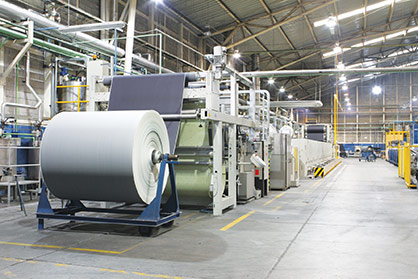
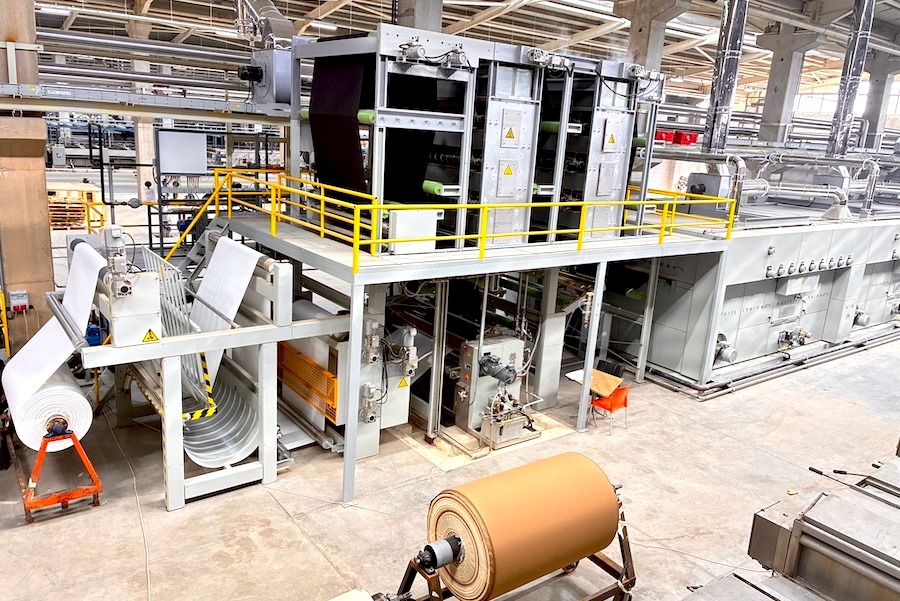
Monforts has a leading position in the field of denim finishing with its well proven Thermex continuous dyeing systems, Montex stenter dryers and other lines for resource-efficient and economical processing. © 2021 Monforts


Sustainable

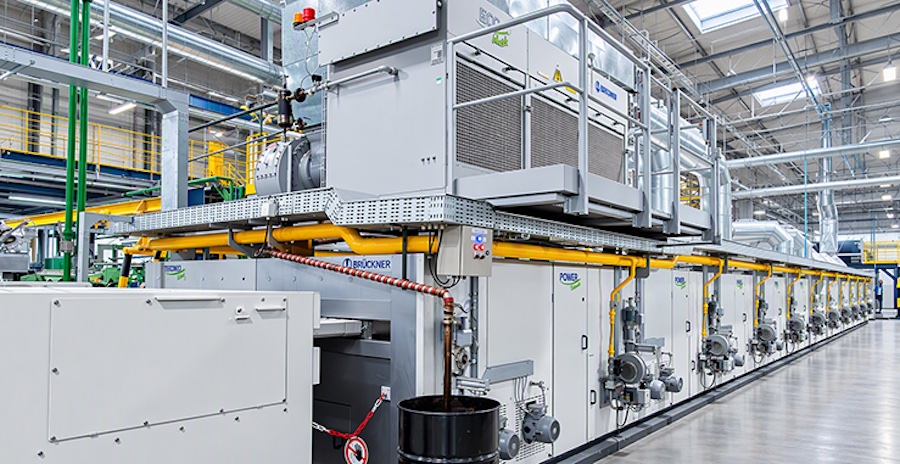
Monforts has a leading position in the field of denim finishing with its well proven Thermex continuous dyeing systems, Montex stenter dryers and other lines for resource-efficient and economical processing.

“Our denim partners are constantly setting themselves new goals in respect of sustainable production – and more importantly, achieving them,” says Hans Wroblowski, Monforts Head of Denim. “We work closely with them with the aim of constantly optimising processing parameters and achieving further savings in energy, water and raw materials throughout the dyeing and finishing stages of production.”

The latest Monforts innovation for denim is the CYD yarn dyeing system. This technology is based on the effective and established dyeing process for denim fabrics that is now being applied for yarn dyeing.

The CYD system integrates new functions and processes into the weaving preparation processes to increase quality, ?exibility, economic viability and productivity.

A full CYD line is now available for trials at the company’s Advanced Technology Centre in Mönchengladbach, Germany.”


More News from A. Monforts Textilmaschinen GmbH & Co. KG

#ITM 2026

New Monforts systems deliver round-the-clock production for Kipaş

As a valued Monforts customer for many years, Türkiye’s Kipaş Textile has just installed a new Thermex dyeing range and a Monfortex sanforizer at its new dyeing and finishing plant in Kahramanmaraş.

#ITM 2026

Monforts sees growing potential for technical textiles in Türkiye

For many years now, Türkiye has been one of the most important markets for textile finishing, coating and continuous dyeing equipment, making ITM 2026 from June 9-13 a key event for Germany’s Monforts. At the Istanbul exhibition at stand 1117D in Hall 11, the company will put the emphasis on its machines which continue to lead the field in conventional dyeing and finishing, and also highlight the strong opportunities for Turkish textile manufacturers in the growing field of technical textiles.

#Dyeing, Drying, Finishing

Monforts unveils interactive digital platform for textile finishers

Monforts has launched a new digital platform designed to give textile manufacturers faster, more intuitive access to the company’s finishing technologies, technical expertise and aftersales support worldwide.

#Techtextil 2026

Monforts to showcase advanced coating solutions at Techtextil 2026

Over the past few years Monforts has significantly advanced its technologies for coating, with the successive introductions of the MontexCoat, coaTTex and VertiDry systems combining flexibility, precision and energy efficiency for the technical textiles market.

More News on Dyeing, Drying, Finishing

#ITM 2026

SETEX turns dyeing and finishing data into daily production control

At ITM 2026, SETEX will show how textile mills can use machine, recipe, quality and energy data for more reliable daily production decisions — not as another reporting layer, but as part of the running dyeing and finishing process. With OrgaTEX X3 MES, E390x/C390x controllers, CamCOUNT and FabricInspector Portable, SETEX connects planning, machine execution and fabric-related quality insight within existing mill structures.

#Dyeing, Drying, Finishing

Tradition and Innovation – Phoenox Textiles Ltd. relies on state-of-the-art carpet back-coating line from Brückner

For more than 70 years, Phoenox Textiles Ltd. has been synonymous with quality, reliability, and inno-vation in the textile industry. Founded in 1954 in Huddersfield (Yorkshire, UK), a region with a long tradition in textiles, this family-owned business has continued to evolve without losing sight of its roots. Today, in its fourth generation under the leadership of the Mosley family, Phoenox successfully combines decades of experience with a clear, forward-looking corporate strategy.

#Dyeing, Drying, Finishing

Smart Quality Control for Technical Textiles

In the end, what matters is the result: a filter that performs reliably, a membrane that remains stable in storm conditions, a composite material with precisely defined properties. But the path to achieving this is demanding. In the production of technical textiles, numerous parameters interact – and even the smallest deviations can have major consequences.

#ITM 2026

The address for environmentally friendly dyeing and finishing systems: ITM 2026

Dyeing and finishing technologies, one of the most critical and value-added areas of the textile sector, have gained strong growth momentum on a global scale. Technologies that are pioneers of this transformation focused on sustainability, quality and efficiency will meet with sector professionals at the ITM 2026 International Textile Machinery Exhibition. Dyeing and Finishing Hall (11–12) will host the latest technologies that increase efficiency, optimize resource use and reduce environmental impact in textile finishing processes.

Latest News

#ITM 2026

KARL MAYER presents a textile TEXTRONIC® innovation at ITM 2026

With highly efficient machines and continuous textile innovations, KARL MAYER underscores its role as a reliable partner for discerning top-tier customers. Just in time for ITM 2026 in Istanbul, the industry leader is introducing a true innovation: an eyelash lace with its characteristic fringed look – combined with a previously unattainable 4-way stretch. While the established fabric could until now only be produced as rigid version or with one-dimensional stretch, the new elasticity in both dimensions expands the possibilities for cross-band panel fabrics.

#Raw Materials

Better Cotton Initiative welcomes new and returning Council members

The Better Cotton Initiative (BCI) has confirmed a series of appointments and reappointments to its Council, the multistakeholder board responsible for BCI’s strategic direction.

#Man-Made Fibers

DYNEEMA® and NP Aerospace advance personal protection for military servicewomen

Dyneema®, owned by Avient Corporation, an innovator of materials solutions, is supplying its high-performance unidirectional (UD) materials to world-leading armor manufacturer NP Aerospace, enabling the production of armor systems designed specifically to fit the female body. With 2,000 new armor systems, including 4,000 plates, made in the United Kingdom (UK) and delivered in June 2026, this collaboration addresses a long-standing lack of high-quality personal protection specially built for female defense and security personnel.

#Man-Made Fibers

Textile Exchange publishes comprehensive polyester LCA study

Textile Exchange has released a new Life Cycle Assessment (LCA) study on polyester, providing detailed data on the environmental impacts of both virgin and recycled polyester production. The study aims to strengthen understanding across the fashion, textile and apparel industries and support more informed decision-making regarding polyester sourcing and production.

TOP