[pageLogInLogOut]

#Dyeing, Drying, Finishing

Half a century of excellence in home textiles
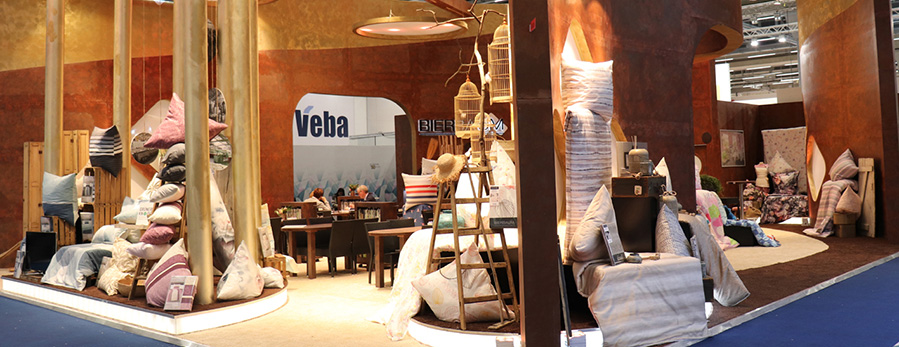
Bierbaum Group’s Heimtextil 2020 stand. The company has exhibited at every edition of the show since 1971. (c) 2020 Monforts
The origins of both Industry 4.0 and an awareness of the need for more sustainable manufacturing methods can arguably be traced back to the year 1971.

It was in 1971 that the first microprocessor was introduced by Intel, and also that the first and perhaps now most well-known environmental campaigner, Greenpeace, was founded.

As such, a direct line can be charted from that year to today’s automated textile manufacturing machinery concepts, as well as the drive to develop more increasingly resource-efficient processes.

All of the recent innovations which have been introduced to the market by A. Monforts Textilmaschinen GmbH & Co. KG, for example, are being powered by the possibilities of Industry 4.0 and developed in response to the market demand for more sustainable production.

They include the new ‘digital twinning’ capability introduced in 2019 for all Monforts machines, with advanced sensor technologies which make it possible to access comprehensive technical machine data from any location using the company’s Smart Support and Smart Check apps. In addition, the digital twin system provides information on individual wear parts, such as, for example, converters or gears.

These latest developments have been very favourably received by Monforts customers, especially in Europe.
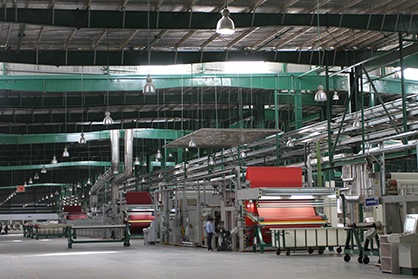
Monforts Montex stenter installation at Trident in India. (c) 2020 Monforts


50th anniversary

The very first Heimtextil – the leading trade fair for the home textiles market – was also held in Frankfurt in January 1971 and Monforts customers Bierbaum Group and Konrad Hornschuch AG are amongst the German companies who were there from the very start and have attended every annual show since.

Bierbaum Group, based in Borken, is the company behind the well-known Irisette bedding brand and is celebrating its own 125th anniversary in 2020. It has also introduced products bearing the German government’s new Grüner Knopf textile seal of approval for sustainable production.

As a specialist in synthetic leathers for home surfaces, as well as vehicle interiors, Konrad Hornschuch AG, of Weissbach, has been a member of the €44 billion automotive giant Continental AG since 2016.

Representatives from both companies received memorial trophies at a special presentation held on January 7th during the 50th anniversary Heimtextil show.

The home textiles market remains very strong in Germany, with sales amounting to some €9.6 billion in 2019, according to analyst IFH Cologne.

Global growth

The first Heimtextil in 1971 was a significant success, attracting 679 exhibitors from 26 countries.

This year’s show, however, attracted a total of 2,952 exhibitors from 66 countries, reflecting not only the growth of the home textiles industry, but also the globalisation which has taken place over the last half century.

Monforts now has customers for its advanced finishing technologies around the world, with home textile customers from India and Pakistan being particularly well represented at Heimtextil 2020.
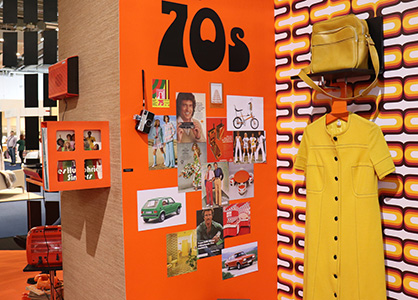
Looking back to the 1970s at Heimtextil 2020. (c) 2020 Monforts


Among stand outs from Indian companies at this year’s show was the 2020 collection of Welspun India’s famous Christy England brand, inspired by botanical studies of the gardens of British stately homes. Welspun towels meanwhile benefit from the company’s HygroCotton hollow core yarn technology, produced by a proprietary spinning method which ensures they become softer, fluffier and more absorbent after every wash.

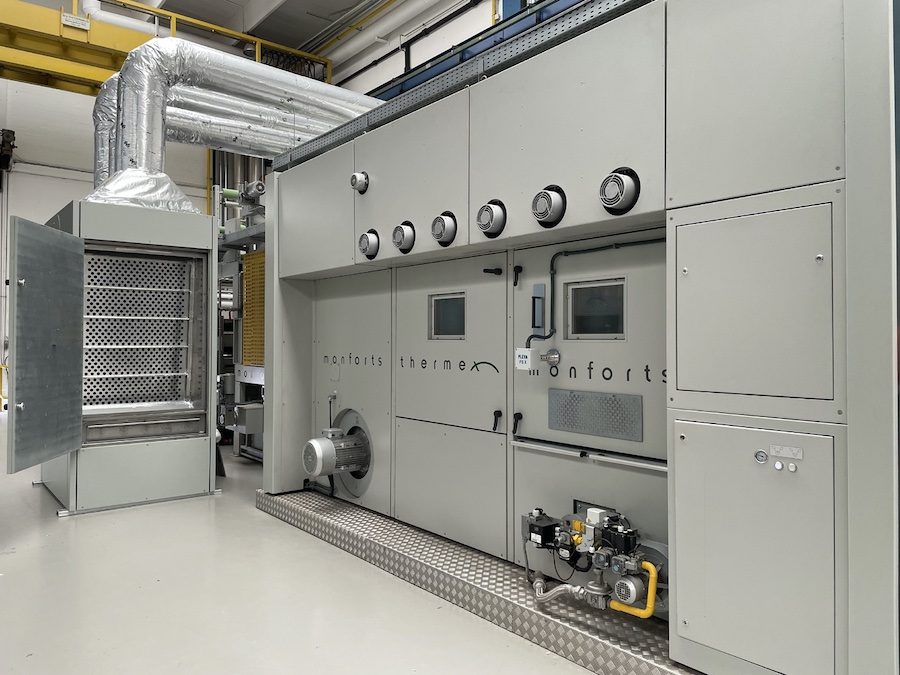
Micoprocessors within Monforts switch cabinets provide today’s Montex stenters with superb flexibility and control. (c) 2020 Monforts


An equally ground-breaking new technology is being introduced by Trident Group, which is one of India’s largest vertically-integrated home textiles manufacturers and two years ago installed five complete Monforts finishing ranges for its new linen department. 

The latest collections of Welspun India’s Christy England brand are inspired by the gardens of British stately homes. (c) 2020 Monforts


Trident’s patented Air Rich yarns feature pores throughout their cross sections for high breathability and absorbency, as well as rapid drying.

Monforts home textile customers from Pakistan stressed the resource efficiency of their processes and products as a result of investments in advanced technology, and during the show the ‘Sustainable Pakistan’ initiative was announced.

Supported by GIZ, the German Society for International Cooperation, the initiative aims to reshape global perceptions of Pakistan’s manufacturers and their innovations. So far, twenty producers have been carefully chosen to be presented on this global platform and will help rebrand Pakistan’s textile industry at the Heimtextil exhibitions going forward.

Heimtextil’s organiser Messe Frankfurt also announced its own new alliance with the United Nations Office for Partnerships, in order to support the UN’s Sustainable Development Goals.

Constancy

Many things have changed since 1971 and home interiors are certainly no longer predominantly orange and brown – and perhaps unlikely to ever become so again. 
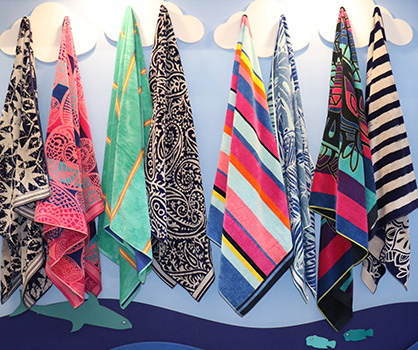
Trident’s towel collections benefit from high breathability and absorbency as a result of the company’s patented Air Rich yarn technology. (c) 2020 Monforts


It’s clear, however, that there has been a constancy in the push to consistently improve textile technologies, processes and products that may have originated in Europe, but have subsequently spread around the world.

And the significance of both microprocessors and sustainability in 2020 could only have been guessed at back in 1971.

More News from A. Monforts Textilmaschinen GmbH & Co. KG

More News on Dyeing, Drying, Finishing

#Dyeing, Drying, Finishing

BW Converting expands Southeast Asian presence with new agency partnerships in Vietnam and Indonesia

BW Converting is strengthening its presence in Southeast Asia through new agency partnerships in Vietnam and Indonesia, reinforcing the company’s commitment to supporting textile manufacturers across the region. The expansion comes as BW Converting prepares to exhibit at SaigonTex 2026 (April 8–11, Saigon Exhibition and Convention Center, Ho Chi Minh City, Vietnam) and INDO INTERTEX 2026 (April 15–18, Jakarta International Expo, Indonesia).

#Dyeing, Drying, Finishing

Orthopac RVMC-20 plus: German Engineering for Smarter Weft Straightening

In times of rising cost pressure and growing quality demands, textile producers worldwide are searching for solutions that combine precision, efficiency, and sustainability. With its latest innovation, the Orthopac RVMC-20 plus, Mahlo once again demonstrates the strength of German engineering: improving proven technology to meet today’s challenges.

#Dyeing, Drying, Finishing

Precision jet dyeing moves towards industrial scale as Alchemie partners with Acatel

BTMA member Alchemie Technology, the pioneer of precision jet dyeing solutions based in Cambridge, UK, is partnering with Acatel, the Portuguese leader in sustainable textile manufacturing. The two companies will work together to validate and optimise Alchemie’s Endeavour system for knitted cellulosic fabrics.

#Associations

AATCC announces 2025 Herman & Myrtle Goldstein Graduate Student Paper Competition winners

The American Association of Textile Chemists and Colorists (AATCC) recognized the winners of the 2025 Herman & Myrtle Goldstein Graduate Student Paper Competition. Founded in 1982 to give student members the chance to conduct and present original research, the competition was renamed in 1994 in honor of Herman and Myrtle Goldstein, following their US$60,000 endowment. Their gift is a lasting remembrance of their dedication to young people in the textile industry.

Latest News

#Techtextil 2026

DIENES at Techtextil 2026: Flexible pilot lines for bio-based fiber development

The growing relevance of bio-based materials in technical textiles is accompanied by increasing demands for reproducibility, high-quality data, and scalable process routes. Especially when working with cellulose and its derivatives, chitosan, lignin-based approaches, or bio-based PAN as a carbon-fiber precursor, R&D teams face variable feedstock quality, tighter process windows, and the need for reliable comparability across trials. This calls for flexible, data-driven experimental setups that can be reconfigured efficiently when recipes, solvents, and raw-material batches change.

#Texprocess 2026

Gunold showcases embroidery product range and services at Texprocess

At Texprocess 2026, GUNOLD will present numerous hands-on examples related to embroidery in Hall 8, Booth E20. The focus is on creative embroidery designs as well as the extensive product range of threads, nonwovens, and accessories for embroidery and embellishment. “Trade visitors can once again look forward to many new and creative embroidery designs. Of course, we will also showcase the matching products required to bring these ideas to life,” announces Marketing Manager Stephan Gunold.

#Nonwovens

EDANA and more than 70 industry organisations call for consistent exemptions in EU packaging regulation

EDANA, together with more than 70 industry associations and organisations, has issued a joint statement commenting on the European Commission’s Delegated Act under Article 29 of the Packaging and Packaging Waste Regulation (PPWR).

#Raw Materials

A Powerful Opening: Global thought leaders launch the International Cotton Conference Bremen

The International Cotton Conference Bremen will open on 25 March 2026 in the Parliament building of the Free Hanseatic City of Bremen with a keynote session of exceptional calibre. Distinguished international experts will set the stage for the conference by offering incisive perspectives on the most pressing challenges and the defining trends shaping the future of the global cotton trade. Their insights will span a broad spectrum — from geopolitically driven disruptions affecting global supply chains to the opportunities emerging from innovation-led agriculture capable of supporting a growing world population. Together, these opening keynotes will frame the dialogue of the conference, highlighting both the complexity of today’s market environment and the pathways toward a resilient and forward-looking cotton sector.

TOP