[pageLogInLogOut]

#Textile chemistry

Devan and Jeanologia join forces to reduce water usage for antimicrobial and skincare finishes for post garment treatments

© 2021 Devan
Devan, leader in sustainable and functional textile finishes, has been working together with Jeanologia, a global leader in sustainable and efficient finishing technologies for textiles, to reduce further water consumption during the application of Devan’s awarded BI-OME® antimicrobial and R-Vital® skincare range.

With increased attention to climate change and limiting excess water consumption in textile production (whether denim or other textiles), Devan and Jeanologia worked together to evaluate the application of Devan finishes onto garments via the patented e-Flow technology.

Devan has been committed to bringing ‘green’ chemistry to the world since the early 1990’s. Jeanologia is an innovative company with over 25 years of experience in the development of sustainable and eco-efficient technologies for the finishing industry.

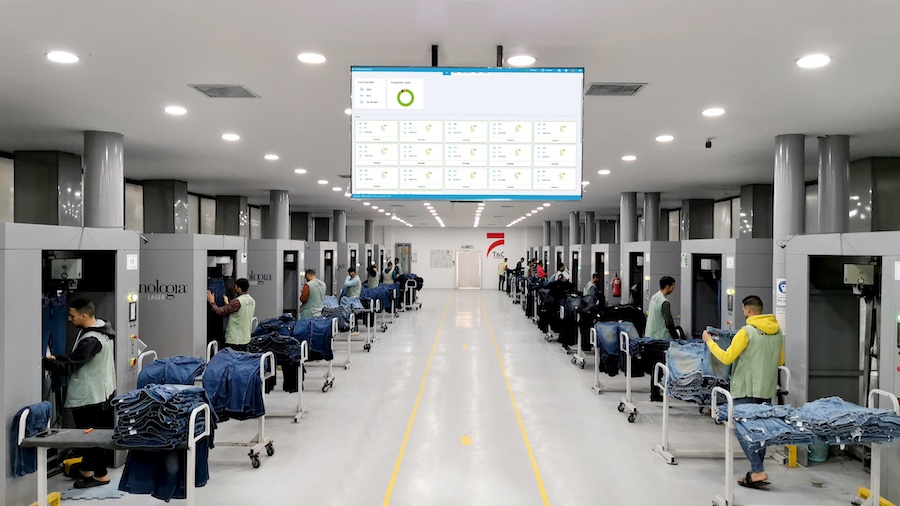
e-Flow technology can accomplish a considerable number of finishing effects with the highest quality, a minimal amount of water and zero discharge. The technology uses micronization and nebulization to substitute traditional abrasion process and deliver performance chemistry using nano-bubbles instead of water. It reduces the cost of application, saves the amount of water used and ensures that the correct amount of chemistry stays in the garment and not in the water. e-Flow is the perfect fit for every industrial washing machine. This allows mills and brands to apply Devan’s technologies in a more sustainable way than using traditional application equipment, even for smaller production runs and direct onto garments.


“With the global textile production using 4% of the global freshwater withdrawal, here at Devan we are continuously working on more sustainable solutions”, says Dr. Vanessa Daelman, CTO at Devan. “Next to this, we of course highly value sustainable application methods from Jeanologia, like e-Flow, in order to reduce the excess water usage during textile application. We are delighted that we could work together with Jeanologia and establish that Devan technologies can be easily applied via these technologies onto garments or fabrics like denim and with full retention of functionality. This application method also allows post garment treatment of our finishes, for example an antimicrobial treatment onto already finished garments, which will be increasingly important in a more circular textile world where re-use plays an important role”, Dr. Daelman concludes.

More News from Devan Chemicals

More News on Textile chemistry

#Textile chemistry

Flame protection and OEKO-TEX® certification: Gulec Chemicals clears an important hurdle

Three halogen-free flame retardants from German specialist Gulec Chemicals have been included in the OEKO-TEX® list of accepted Active Chemical Products (ACP). The listing opens up additional opportunities for textile finishers, coaters and manufacturers of technical textiles seeking to combine demanding fire protection requirements with certification according to OEKO-TEX® STANDARD 100.

#Textile chemistry

PFAS restrictions drive innovation in waterproof breathable fabrics

Innovation in waterproof breathable fabrics and apparel is being driven by legislation restricting the use of per- and polyfluoroalkyl substances (PFASs) as manufacturers develop alternative membranes and finishes for use in outdoor apparel, according to “Waterproof breathable fabrics: changing legislation is driving innovation”, a 50-page report from the global business information company Textiles Intelligence.

#Techtextil & Texprocess 2028

Techtextil and Texprocess 2028 strengthen networking and business opportunities along the textile value chain

Techtextil and Texprocess are preparing for their next editions from 4 to 7 April 2028 in Frankfurt with an optimised hall layout designed to strengthen connections across the textile value chain. The new structure brings materials, production technologies and processing solutions closer together, while several leading international companies have already confirmed their participation. Exhibitors can benefit from early-booking rates until 30 November 2026.

#Textile chemistry

Archroma and Prosperity Textile to collaborate on denim innovation

Archroma, a global leader in specialty chemicals, and Prosperity Textile, an international fabric manufacturer with production bases in China and Vietnam, have announced a partnership to drive denim innovation. They will collaborate to develop, evaluate and implement new approaches to improve denim aesthetics, durability and performance, with a shared commitment to sustainability.

Latest News

#Textile processing

Jeanologia combines digitalisation, laser and ozone technology to strengthen China’s textile competitiveness

At ITMA Asia + CITME 2026 in Shanghai, Jeanologia showcased how the combination of digitalisation, laser technology and G2 Ozone can help China’s textile industry improve productivity, speed, quality and efficiency. With its Compact Super Flash laser system and integrated production concepts, the Spanish technology specialist demonstrated how connecting product development and industrial production can enable faster, more automated and sustainable manufacturing processes.

#Dyeing, Drying, Finishing

PLEVA improves dyeing consistency with inline microwave measurement of liquor pick-up

Consistent shades are essential in continuous textile dyeing. Yet variations in fabric absorbency or uneven padder pressure can go unnoticed until the end of the line. By then, hundreds of metres of fabric may already be affected and may become second-choice or rejected.

#Recycling / Circular Economy

DITF establishes CYCLOTEXUM recycling center to advance mechanical and solvent-based textile recycling

As part of the CYCLOTEXUM research project, the German Institutes of Textile and Fiber Research Denkendorf (DITF) established the CYCLOTEXUM recycling center. There, in collaboration with industry partners, the center develops application-oriented solutions for mechanical and solvent-based recycling processes. The technologies developed make a significant contribution along the textile value chain toward the efficient use of textile resources in the future and the transition of production in the German textile sector to a circular economy. The project was funded by the Ministry for the Environment, Climate and Energy Sector of the State of Baden-Württemberg.

#ITMA 2027

CEMATEX outlines future exhibition strategy for ITMA 2027 and ITMA ASIA Singapore 2029 at ITMA NEXT

At the ITMA NEXT | Industry Networking event on 22 November in Shanghai, CEMATEX unveiled its plan for ITMA ASIA Singapore 2029, marking a new chapter under its sole organisation and management. CEMATEX also highlighted exciting initiatives for ITMA 2027, inviting the global textile and garment technology community to convene in Hanover to discover breakthrough innovations, exchange insights and forge partnerships that will shape the future of textiles.

TOP