[pageLogInLogOut]

#Associations

EURATEX & ATP Convention successfully concluded in Porto: European textile industry needs to prepare for a paradigm shift, and become global leader in sustainable textiles
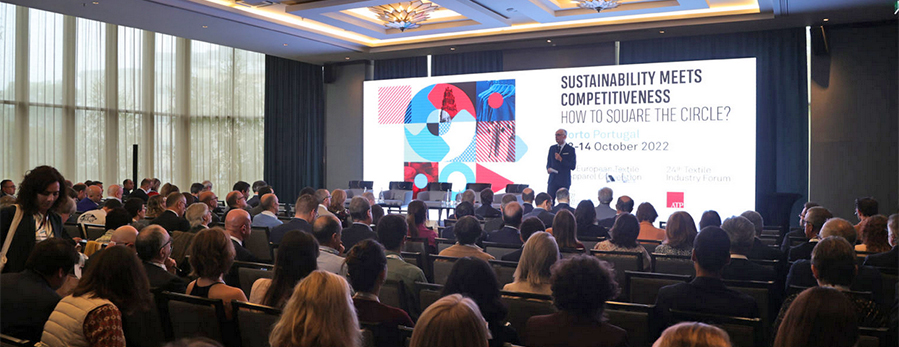
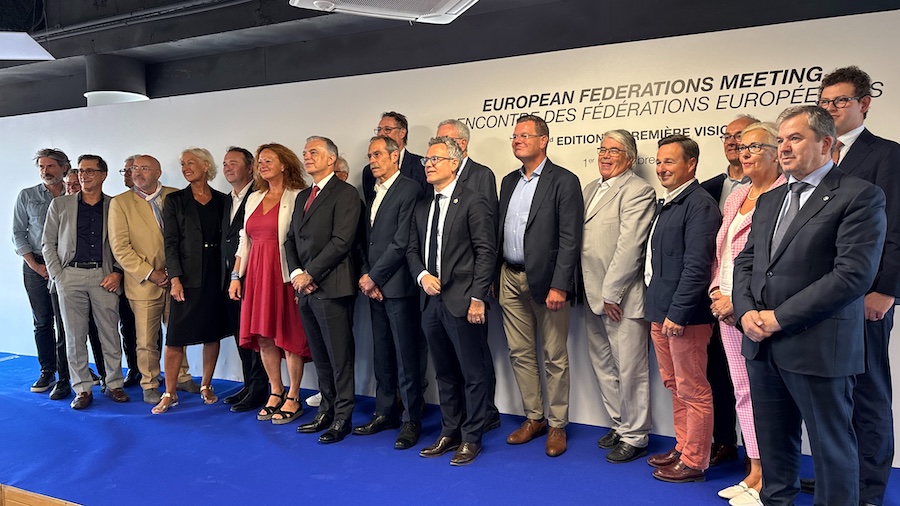
EURATEX Porto Convention © 2022 EURATEX
Organised by EURATEX in partnership with the Portuguese Textile Association (ATP), the Porto Convention – Sustainability meets Competitiveness: How to Square the Circle? – took place on 13-14 October in Porto, Portugal, with nearly 250 entrepreneurs attending from all over Europe. They discussed the current challenges of the European textile industry and set the grounds for a bright future, based on some strong foundations: innovation, creativity, quality and sustainability.

In his keynote speech, Mr. Pedro Siza Vieira, Former Minister for the Economy and Digital Transition of Portugal, assessed the geopolitical and macroeconomics changes, and how this will impact on the future of the textile industry: nearshoring and friend-shoring, independence from foreign gas through the use of European sustainable energy, as well as circular and automated production lines. While the current turbulence causes uncertainty, he sees a better future for our industry.

The first CEO Panel, addressing the theme of How to Measure and Communicate about Sustainability, focused on the challenges to translate “sustainability” towards the consumers. The panel addressed the issue of greenwashing and the role of brands in communicating about sustainability. It looked at how the new European Commission regulations on eco-label, digital product passport (:) and product environmental footprint (PEF) will create a new framework.

The second CEO Panel, discussing Financing Sustainability, looked at the cost of sustainable investments, and how this cost should be managed within the entire supply chain, including the brands and retailers.

Four workshops with industry experts followed in the afternoon, addressing the themes of Extended Producer Responsibility (EPR) in Textiles, Digital Product Passport (:), Recycling Textile Waste and Labelling Textiles (Product Environmental Footprint). As these initiatives will roll out in the coming years – as part of the EU Textile Strategy – participants got a better understanding of the future framework for our industry.

Dirk Vantyghem, Director General of EURATEX, commented on this: “to prepare for a brighter future requires a new regulatory framework, where quality and durability become the norm, where transparency and sustainability is rewarded, where free riders – who do not comply with rules and standards – are kept outside the market. The EU Textile Strategy aims at creating such a framework, which must be fair and balanced, and requires a close and constant dialogue between the regulator and the industry.”


During the 2nd day of the convention, participants had the opportunity to visit state of the art textile companies (Têxteis J.F. Almeida, RIOPELE, and TMG Automotive) and the Portuguese textile research centre CITEVE. They showcased how the Portuguese textile industry is making this transition, while remaining globally competitive.

Alberto Paccanelli, President of EURATEX, concluded: “We need to attract creative people in our companies, we need to produce top class quality products, and we need to become more sustainable. That is the recipe for our success in a globalised and highly competitive industry.” Paccanelli is positive about the future: “While we face very tough times, I am optimistic about the future of our European textile industry. The rest of the world is watching us, as we move forward with our strategy. We should become their benchmark and Europe should become a global leader in sustainable textiles.”

For further information and details about the speaker panels, you may consult the convention website – https://portoconvention.eu/ – or contact Cristina Gatti (cristina.gatti@euratex.eu).

More News from European Apparel and Textile Confederation (EURATEX)

#Europe

European textile industry calls for €10 handling fee on ultra-fast-fashion imports

The introduction of the €3 customs duty on low-value imports marks an important milestone in Europe’s efforts to address the challenges created by the rapid growth of ultra-fast-fashion imports. Together with the abolition of the €150 customs duty exemption, it demonstrates that policymakers are willing to act when market distortions become impossible to ignore. However, the European textile and clothing industry considers this a first step rather than the final destination.

#Associations

Towards pragmatic and harmonised labelling in the EU

EDANA, alongside 14 European associations, urges the European Commission and Member States to adopt a pragmatic approach for the future harmonised packaging labels, in line with the EU’s agenda for the EU Single Market, simplification and competitiveness. The system should rely on text-free pictograms, available in achromatic or monochromatic versions matching the packaging palette, with the possibility of using digital labelling as a core element. Our associations represent manufacturers of consumer goods across Europe.

#Associations

Textile PRO Forum calls for greater harmonisation of textile EPR systems across Europe

The Textile PRO Forum has published a new analysis highlighting the need for greater harmonisation of textile Extended Producer Responsibility systems across Europe. The document, Toward harmonised Textile EPR Systems in Europe: analysis and recommendations, presents the results of work carried out by Workstream 1 of the Textile PRO Forum, led by Dr. Eng. Viola Corbellini, Strategic Development and Innovation Expert at Erion Textiles, and Eng. Luca Campadello, General Director at Erion Textiles. The workstream focused on reducing administrative burden for textile producers by identifying areas where procedures could be better aligned across countries.

#Associations

Mario Jorge Machado re-elected President of EURATEX

The EURATEX General Assembly has re-elected Mario Jorge Machado as President of EURATEX, renewing its confidence in his leadership at a crucial moment for the European textile and clothing industry. The sector is facing rising costs, global competitive pressure and an increasingly challenging transition towards sustainability and digitalisation.

More News on Associations

#Associations

Business situation weakens slightly, but the industry stays cautiously optimistic

The International Textile Manufacturers Federation (ITMF) has published the results of its 39th Global Textile Industry Survey (GTIS), conducted from 14 to 22 July 2026 among companies along the entire global textile value chain. Worldwide, 10% of participants rated their business situation as good, 53% as satisfactory and 37% as bad — a balance of -26pp, down from -17pp in May but still well above the 2023 lows. All regions are now in negative territory, from South Asia at -3pp to North & Central America at -58pp.

#Associations

IVGT membership: expertise that pays off

For energy-intensive textile companies, government compensation mechanisms are an important economic factor. The IVGT successfully supports its member companies in applying for state aid and thereby regularly contributes to significant financial relief.

#Associations

Italian textile machinery orders show quarterly recovery in Q2 2026

In the period between April and June 2026, order intake for Italian textile machinery manufacturers showed mixed but encouraging signals for the second half of the year. The order index at constant prices stood at 46.6 points (taking 2021=100 as the base year), showing a slight decrease of 3% compared to the same quarter of 2025. This trend was largely due to the contraction recorded in the domestic market, which fell by 25% compared to the corresponding period of the previous year.

#Associations

Consolidation amidst difficult market conditions

The International Textile Manufacturer Federation has published its International Textile Industry Statistics (ITIS) on productive capacity and raw materials consumption in the short-staple organized (spinning mill-) sector in virtually all textile-producing countries in the world.

Latest News

#Research & Development

From smart jackets to laser technology: Mona Neubaur explores Textile Factory 7.0

As part of her summer tour, North Rhine-Westphalia’s Minister for Economic Affairs and Climate Action, Mona Neubaur, visited Textilfabrik 7.0 in Mönchengladbach to experience the project’s innovations first-hand. Under the motto “smart and clean”, the visit focused on innovative technologies and sustainable alternatives for textile production - from smart jackets to the decolourisation of textiles using fungal cultures.

#CINTE Techtextil China 2026

Cinte Techtextil China 2026 has opened today, bringing global innovations and resources to Shanghai

As Asia’s premier platform catering to the evolving needs in technical textiles and nonwovens, Cinte Techtextil China has opened today at the Shanghai New International Expo Centre, gathering over 300 exhibitors from 15 countries and regions. Across Halls W3 to W5, this edition will create chances for fast-growing sectors and emerging trends – such as Mobiltech, Medtech & Protech, Indutech and more. The curated zones, pavilions, and fringe programme are designed to better connect exhibitors with targeted buyers from across China, Asia-Pacific, and further afield. Meanwhile, the Association Village will gather international industry associations to foster even more global collaboration.

#Textiles & Apparel / Garment

Texworld Apparel Sourcing Paris opens with focus on AI, circularity and new sourcing regions

More than 1,000 exhibitors from around the world are gathering at Paris-Le Bourget as Texworld Apparel Sourcing Paris opens its doors from August 31 to September 2. With around 500 textile manufacturers and a similar number of apparel and accessories suppliers, the trade fair reflects the ongoing transformation of global sourcing and the growing diversification of supply regions.

#Raw Materials

Brazil sets new cotton export record and consolidates global leadership

Brazil ended the 2025/26 commercial year with a new record, consolidating its position as the world’s largest cotton exporter. Between August 2025 and July 2026, the country shipped 3,373,941 tonnes of the fiber, 19% more than in the previous cycle, and reached record revenue of US$5.3 billion. The result represents a milestone in Brazil’s expansion in the international market and reinforces the country’s role as a strategic supplier to the global textile industry.

TOP