[pageLogInLogOut]

#Associations

ITALIAN TEXTILE MACHINERY: Falling orders for third quarter 2019

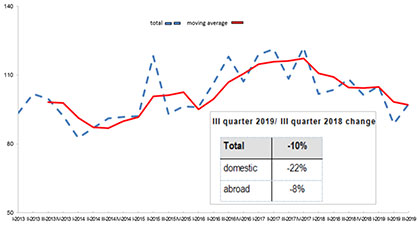
The orders index for textile machinery compiled by ACIMIT, the Association of Italian Textile Machinery Manufacturers, from July to September 2019 was down by 10% compared to the same period in 2018. The value of the index came in at 97.4 points (basis: 2015=100).

New orders for Italian machinery manufacturers were negative both in foreign markets and in Italy. Abroad, an 8% decrease was recorded, with an absolute index value of 98.9 points. The drop in domestic orders was even more pronounced, at -22% compared to the third quarter 2018. The absolute value of the index was 94.9 points.

Alessandro Zucchi, president of ACIMIT, commented the market situation: "The orders index for the textile sector provides a true picture of the global market’s downsizing. Current geopolitical tensions are undermining the climate of trust for businesses that need to invest. In Italy, uncertainties linked to future processes relating to the Industry 4.0 plan have effectively slowed demand for machinery. I hope that the current government will continue on the path set out by the previous administrations.


"We don’t expect any changes of course for the current trend this year,” concludes Zucchi, adding that, “Exports data, updated to the first six months of the year, confirm an overall negative progression compared to the same period for 2018, with the exception of the Chinese market, which is experiencing growth. However, we expect a boost in investments in 2020."
(c) 2019 ACIMIT
(c) 2019 ACIMIT


More News from

More News on Associations

#Raw Materials

Cotton Brazil Dialogues 2026 concludes with 50 international participants immersed in Brazilian cotton production

The Cotton Brazil Dialogues concludes its 2026 edition after a series of technical visits to farms, cotton gins and reference centers, as well as workshops focused on Brazilian cotton production. A total of 50 participants from 14 countries took part in the field trips. The initiative is led by the Brazilian Association of Cotton Growers (Abrapa) and the National Association of Cotton Exporters (Anea), with support from the Brazilian Trade and Investment Promotion Agency (ApexBrasil).

#Europe

European textile industry calls for €10 handling fee on ultra-fast-fashion imports

The introduction of the €3 customs duty on low-value imports marks an important milestone in Europe’s efforts to address the challenges created by the rapid growth of ultra-fast-fashion imports. Together with the abolition of the €150 customs duty exemption, it demonstrates that policymakers are willing to act when market distortions become impossible to ignore. However, the European textile and clothing industry considers this a first step rather than the final destination.

#Associations

Business situation weakens slightly, but the industry stays cautiously optimistic

The International Textile Manufacturers Federation (ITMF) has published the results of its 39th Global Textile Industry Survey (GTIS), conducted from 14 to 22 July 2026 among companies along the entire global textile value chain. Worldwide, 10% of participants rated their business situation as good, 53% as satisfactory and 37% as bad — a balance of -26pp, down from -17pp in May but still well above the 2023 lows. All regions are now in negative territory, from South Asia at -3pp to North & Central America at -58pp.

#Associations

IVGT membership: expertise that pays off

For energy-intensive textile companies, government compensation mechanisms are an important economic factor. The IVGT successfully supports its member companies in applying for state aid and thereby regularly contributes to significant financial relief.

Latest News

#Knitting & Hosiery

KARL MAYER launches extra-wide HKS 3-M EL for increased productivity

KARL MAYER has launched a new extra-wide version of its HKS 3-M EL tricot machine, designed to increase productivity particularly in the manufacture of textiles for sports, activewear and athleisure applications.

#Research & Development

Reducing development times for technical textiles by accelerated thermo-oxidative aging in a high-pressure autoclave

Synthetic polymers used in technical textiles can be effectively protected against degradation caused by heat, oxygen, and water through the use of stabilizer systems. This enables service lives of several decades, extending to more than 50 years. As the use of durable technical textiles continues to grow, so does the demand for reliable methods to predict their service life within economically feasible testing periods. For the first time the German Institutes of Textile and Fiber Research Denkendorf (DITF) developed methods for robust service life prediction for textiles in an IGF research project.

#Research & Development

ITA has developed a washable digital smart jacket with real-time feedback and an AI-powered app for rehabilitation

As part of the PhysioTaix research project, the Institut für Textiltechnik (ITA) of RWTH Aachen University is developing a digital smart jacket with integrated sensors. The jacket is washable and reusable; it tracks movements during rehabilitation exercises in real time and transmits the data to an app.

#Nonwovens

25 years in the room: EDANA’s OUTLOOK™ returns to Cascais to shape a changing industry

The market does not wait, and it does not grant easy answers. Across the absorbent hygiene, personal care, and wipes sectors, business is undergoing a period of intense, necessary adjustment. New European rules on packaging, single-use items, product safety, and end-of-life are forcing companies to drop old assumptions about materials and performance. At the same time, producers must keep their goods safe, reliable, and affordable for the babies and aging adults, who rely on them every day.

TOP