[pageLogInLogOut]

#Sustainability

Textile Exchange reports global production of organic cotton increases 56 percent

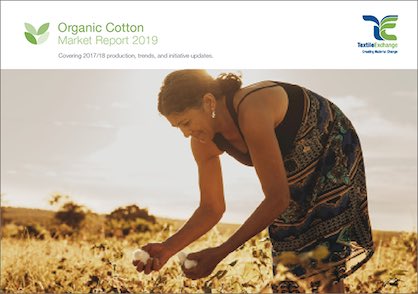
Textile Exchange’s 2019 Organic Cotton Market Report reveals that 2017/2018 saw an impressive 56 percent growth in global organic cotton production, with India, China, and Kyrgyzstan as the biggest contributors to this increase.

Latest figures show that global production of organic cotton fiber reached 180,971 metric tons (MT) in 2017/2018 - the highest volume seen since 2009/2010 when the financial crisis led to a dramatic decline. Textile Exchange, the only organization to collect and report on global organic cotton production data, estimates that this growth is set to continue, with India, Tanzania, Turkey, Kyrgyzstan and China all having significant areas of cotton-growing land in transition to organic.

The number of facilities certified to voluntary organic standards is also on the rise, with facilities certified to the Global Organic Textile Standard and Textile Exchange’s Organic Content Standard growing by 15 and 16 percent respectively.

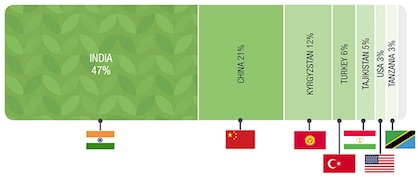
Cotton is grown organically in 19 countries around the world and the Organic Cotton Market Report reveals that 98 percent of the production stems from just 7 of these: India (47 percent), China (21 percent), Kyrgyzstan (12 percent), Tukey (6 percent), Tajikistan (5 percent), the United States (3 percent), and Tanzania (3 percent).

Organic cotton now makes up 0.7 percent of total cotton production globally. In 2017/2018, the fiber was planted on a total of 356,131 hectares (ha), with an additional 44,394 ha in transition to organic. Production was carried out by a total of 182,876 farmers, the majority of whom were smallholders growing organic cotton in rotation with other crops. An interesting trend, identified in India this reporting year, was that organic cotton farmers increased the proportion of certified land used to grow cotton (as opposed to other organic crops) from 45 to 70 percent, which contributes in part to the 44 percent growth seen in India’s production.
(c) Textile Exchange


(c) 2019 Textile Exchange

Farmer access to cotton seed that has not been genetically modified (GM) remains a huge obstacle for organic farmers, particularly in countries such as China and India where GM cotton dominates the cotton landscape. The report highlights some of the great progress being made in this area and includes an urgent call to action for added investment in non-GM seed programs, as well as for companies to develop their own organic cotton safeguarding programs.

With the rise in awareness of the climate emergency that our planet is facing, Textile Exchange sees organic cotton as a key component to the myriad of solutions that are urgently needed. Liesl Truscott, Director of European & Materials Strategy at Textile Exchange, said:

“Organic cotton, alongside other organic land-based fibers, must be part of the future. Organic cotton farmers, organizations, companies, and other supporters represented in this report provide a guiding light. We are proud to bring you our 2019 Organic Cotton Market Report and are committed to leveraging organic cotton as a market-driven solution to industry transformation and meeting the Global Goals.”

Textile Exchange’s Managing Director, La Rhea Pepper, also believes wholeheartedly in the importance of this fiber in driving change:

“Organic production of cotton is the tip of the spear that has been driving change within the sector. It establishes a direction of travel for all of us, starting with regenerative soil practices.”

The 2019 Organic Cotton Market Report provides a unique overview of global organic cotton production, focusing on the 2017/2018 harvest year but including both historical trends and forecasts at global, regional, and country levels. Also included are stakeholder maps identifying the key initiatives working hard to support organic cotton in each region, alongside latest updates from many of these programs and Q&As with industry insiders.

Download the full 2019 Organic Cotton Market Report

https://store.textileexchange.org/product/2019-organic-cotton-market-report/

More News from Textile Exchange

#Sustainability

Textile Exchange evolves its membership structure to unlock the next stage of collective action for climate and nature

Textile Exchange is excited to announce that it is evolving its membership structure to a more action-oriented, impact-driven model designed to provide clearly defined pathways that help organizations respond to the climate and nature crisis.

#Sustainability

Key takeaways from the 2025 Textile Exchange conference

Brands and retailers, suppliers, innovators, recyclers, farmers, non-profit organizations, and academics convened at Textile Exchange’s Annual Conference, held in the Lisbon Conference Centre.

#Sustainability

Textile Exchange announces the winners of the 2025 Climate and Nature Impact Awards

Textile Exchange is pleased to announce the winners of the 2025 Climate and Nature Impact Awards. These awards recognize individuals and partnerships making progress toward a regenerative and equitable raw materials economy.

#Sustainability

Textile Exchange Conference 2025: Setting the course for systemic change

The 2025 Textile Exchange Conference brought together more than 1,600 participants on site in Lisbon and online, marking two days of intense dialogue on the future of sustainable and regenerative material systems. With a focus on collaboration, data-driven progress, and systemic transformation, the sessions highlighted both the challenges and the opportunities in building a truly resilient textile industry.

More News on Sustainability

#Sustainability

YKK recognized with Top ‘A’ rating by CDP for climate change leadership for third consecutive year

YKK Corporation announced its achievement of the highest “A List” rating in the 2025 Climate Change survey conducted by the global environmental disclosure nonprofit, CDP . This marks the third consecutive year YKK has received this prestigious recognition.

#Weaving

Itema announces strategic partnership with Ivy Decarb to accelerate decarbonization in weaving process

Itema is pleased to announce the strategic partnership with Ivy Decarb, the digital platform helping textile companies measure and reduce their carbon footprint.

#Man-Made Fibers

Teijin Carbon Europe receives EcoVadis Silver status – ranked among the top 15% of evaluated companies

Teijin Carbon Europe (TCE) has been recognized for its sustainability performance and has been awarded the EcoVadis Silver Medal in the latest assessment. In its first-ever EcoVadis evaluation, the company achieved a notable 72 out of 100 points, ranking among the top 15% of all companies evaluated worldwide, within the “Manufacture of Man-Made Fibres” category.

#Research & Development

The region of renewable raw materials: Central German Alliance for Bioplastics

The development of sustainable plastic solutions is rapidly gaining importance in light of global environ- mental pollution, dwindling fossil resources and ambitious climate protection targets. As part of the re- gional alliance RUBIO, which brings together 18 partners from central Germany and the Berlin-Branden- burg area, the bio-based and biodegradable plastic polybutylene succinate (PBS) was comprehensively investigated, starting with the raw material, through the manufacturing process, to industrial application.

Latest News

#Natural Fibers

38th International Cotton Conference Bremen: Let´s Talk about Cotton!

The 38th International Cotton Conference Bremen, to be held on 25-27 March 2026 in Bremen’s parliament building on market square, once again sends a powerful signal for professional excellence and international dialogue. The focus is on the latest market trends and technical innovations throughout the entire value chain – from agriculture and quality assurance to processing and the circular economy. With its high-calibre speakers, the conference remains an indispensable forum for anyone involved in shaping the cotton industry scientifically, technically, or economically.

#Recycled_Fibers

Leading fashion brands step up to unlock the next chapter of Circulose

Since 2024, under new ownership and leadership, Circulose has set a renewed strategic direction focused on securing long-term commitments with partner brands to bring CIRCULOSE® back to market at scale. This strategy has proven successful.

#Research & Development

More safety and comfort for protective clothing thanks to auxetic fabrics

When everyday materials are pulled, they stretch or elongate in the direction of the pull and become narrower in cross-section. We can also observe this property in two-dimensional textiles. Auxetic structures behave differently here. They have the striking property of not changing under tensile stress or even increasing their width or thickness. These properties are advantageous, for example, in protective textiles or textile filter media. The DITF are researching auxetic fabrics for various applications.

#Recycled_Fibers

Recycling mixed-fibre garments becomes a reality: RadiciGroup, The LYCRA Company and Triumph take circular fashion a step forward

The process, which is both economically and environmentally sustainable, has enabled the production of an underwear set made from 100% recycled nylon and LYCRA® fibre in a closed-loop system.

TOP