#Textiles & Apparel / Garment
Merino wool wrap up report from the catwalks for Autumn/Winter 2013
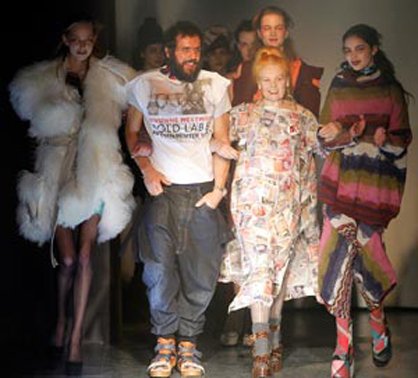
+ Vivienne Westwood presents at Paris Fashion Week
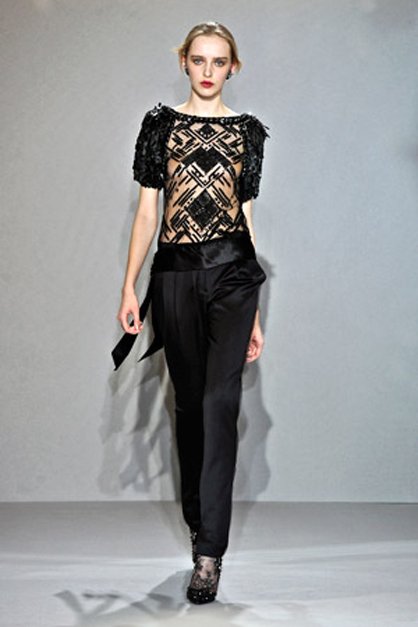
+ Model showcases Collette Dinnigan at Paris Fashion Week
In fact, it was already evident in Alexander Wang’s eye-teasing raincoat made from lacquered Merino wool, or his gauzy Merino jacquards which literally shrink-wrapped the body.Laura and Kate Mulleavy, the sisters who design the Rodarte label, are specialists in the fashion surreal, but they rooted their new collection in the most primal environment imaginable – the Australian Outback. It naturally followed that wool would be their foundation, spun into solidly pioneer looks or ethereal, escapist lace. That same sense of possibility infused collections as distinctly different as Donna Karan’s – she drew on a dandified menswear element for a tailored coat-dress – and Francisco Costa always-avant garde collection for Calvin Klein, which textured wool with the use of needle-punching, one of the fashion industry’s favourite new techniques for injecting tactile interest into clothing.
The keynote of Milan’s fashion week this season was drama – both on the catwalk, and off, with the abrupt departure of designer Raf Simons from the house of Jil Sander where, for seven years, he had been one of the most influential forces in the industry. His final show was a beautifully modulated presentation of pale-toned coats and dresses, which showed a man in full mastery of fabric, cut and silhouette. The audience cheered and wept in scenes that were unprecedented at a fashion show.
It was ironic that so much emotion could be engendered by so much serenity, especially when Milan’s other catwalks struck more obvious dramatic chords this season, primarily with an oversized military mood and an appetite for black that was so insatiable it bordered on the Gothic. The item that united those trends was the cape. It didn’t have to be black - Consuelo Castiglioni showed a spectacular crimson version for Marni – but its dominance means Autumn/Winter 2013 is a banner season for Merino wool.
At Gucci, Frida Giannini invoked “dark glamour” as the reference point for a collection that borrowed equally from a Viennese riding academy and the romance of the 19th century Pre-Raphaelite movement in England. Romance was Dolce&Gabbana’s cue too, but their inspiration was Baroque of Sicily, which has been the design duo’s main inspiration since they launched their business over 25 years ago. They encrusted clothes that were almost uniformly black with gold embroidery. Black as a canvas for embellishment was also a story at Emilio Pucci, where Peter Dundas lacerated double-faced wool dresses with slashes of chiffon.
The light-absorbing properties of black made it the perfect shade for the dense, contouring wools that Tomas Maier selected for his outstanding collection for Bottega Veneta. Maier’s fabric technology is innovative but subtle. Silvia Fendi also saluted the possibilities of wool mutated by technology by giving the fibre a fur-like feel. Angela Missoni did it with needlepunching, creating strange organic hybrids out of knits, lace and animal skins.
Missoni’s inspiration was the infinitely rich natural world. It was manmade military concerns that inspired Massimiliano Giornetti’s collection for Salvatore Ferragamo, which matched rigorous army tailoring to delicate chiffons, lace and lame. And Miuccia Prada, always a benchmark in Milan, brought the natural and the manmade together, in a collection which layered outerwear mutated from menswear over skirts and the cropped pants that are one of the season’s universal trends. Then she studded the lot with huge crystalline embroideries. The combination of strict proportion and elaborate decoration felt like a glimpse of fashion’s future.
Paris is always the fashion capital with the widest gamut of style statements, from the most classic to the most avant-garde. This season, it was significantly the classic houses that made the strongest showing, but not by playing it safe. One of the best examples: the strong, boldly linear Valentino collection which featured complex, colourful jacquards drawn from folklore patterns, counterpointed by sober but masterfully tailored pieces in full-bodied wools. This idea of explicit contrast could also be found in Karl Lagerfeld’s collection for Chanel, which matched the crystalline forms of nature to the Cubist art of man. Chanel’s knits had a geometric flair, or the mineral sparkle of mica. And Lagerfeld showed the jacket-over-skirt-over-pants silhouette, already seen at Prada in Milan and also cropping up in the Louis Vuitton collection at week’s end.
The oversize outerwear that was a Milan trend continued into Paris. The big, man-styled coats at Celine are sure to be one of the season’s most editorialised looks. Balenciaga’s version was a little edgier, with bright-coloured lapels. Some of the best versions were to be found in Neil Barrett’s collection. With a family tradition of military tailoring to back him up, Barrett cuts a mean peacoat and duffel.
A militarily precise cut lends itself to dandy-ism (one reason why Beau Brummel is considered the father of modern menswear), so, in a season when there has been a distinct military influence, it followed that the dandy wasn’t far behind. Haider Ackermann has already proved himself an extraordinary colourist. His colours were even more striking when delivered in shapes simpler than his fantastic signature silhouettes. Dries van Noten lavished gilded Chinese embroideries on tailored navy and grey flannel, an East-meets-West culture clash that produced some of the season’s most memorable looks. And, when it comes to memorable, it was hard to match Sarah Burton’s collection for Alexander McQueen. Just about as hard as it was to determine exactly what fabrics she was using, though it was, in fact, wool in the opening section of winter white jacquards.
“I rely on historical reference,” said Woolmark ambassador Vivienne Westwood, whose collection was long on the subverted aristocratic traditions – the windowpane checks, plaids and houndstooths tailored into extreme shapes – that are her signature. She used wool in hidden ways as well, as the lining on a silk coat, for example. Colette Dinnigan, another Woolmark ambassador was on the schedule at Paris Fashion Week. She sculpted Merino into body-conscious cocktail dresses, detailed with lace, and occasionally wrapped in stoles of looped wool and feathers, an idiosyncratic combination of glamour and practicality, which could be a definition of wool itself.
Designer Quotes:
Instead of being obsessed with fabrics that were completely soft, we wanted everything to have a base in wool, something beautiful and delicate that is also utilitarian. That really guided the way we built the collection. We were obsessed with every type of wool that you could imagine, so a really amazing guipure lace would be made in wool, and you’d think it was mohair. Or if we would go into the shearling element or the fisherman’s sweater, and I feel that lends itself to a certain kind of wool. But when we wanted to use dusty blue in wool, I could only imagine something very tailored.
Laura Mulleavy, ]Rodarte
Wool is the cotton of winter. It always had a luxurious connotation, but with new innovations, it's become even more special.
Jason Wu
If I could only use one fibre, it would be wool. You can't beat that versatility, from cosiness to absolute luxury.
Michael Kors
Wool brings not just warmth but roundness. When it’s mixed with silk, it gives a roundness – a bounciness - that silk doesn’t have. That’s why I love to use it for evening. It’s very enveloping – and of course, it’s natural too.
Yvan Mispelaere, Creative Director, Diane von Furstenberg
Wool is the greatest fabric for tailoring, which was an important part of the Fall/Winter collection. It can come in so many ways that it can find its place in all seasons, from tropical wool for extremely hot climates to heavy woolens for rough outdoor weather. In the new collection we focused on extreme density given by a compact and close weft construction. This also gives a very rounded surface and turns seams into a very fine line. Our second focus went to wool crepes, which can have the same density and opaque aspect but has a characteristic natural give. Used in closely tailored dresses, this material gives a sense of freedom to the woman without involving artificial fibers in the weave composition. The very fine quality of yarns obviously makes a difference in terms of price. Wool represents probably 35% of fabric used in this Fall collection but, as I said, is an important asset in every collection throughout the year.
Tomas Maier, Creative Director, Bottega Veneta
Wool has so much body it just feels more luxurious. We really appreciate wools, especially here, because they are so different. It’s always a challenge to make it new each season. But Italians like to keep pushing the fibre forward, with treatments for instance. This season, we used a glass treatment. And we particularly like dry wools. We choose all the yarns, all the checks are made for us.
Molly MalloyHead of Womenswear, Marni
Wool is necessary for humanity. And you need wool to create special effects. We always find lots of new fabrics in Biello, near Torino. Like the way we combined wool and chiffon together in this collection. You iron them together, the wool shrinks and the chiffon bubbles up through the wool like an astrakhan.
Stefano Gabbana, Dolce&Gabbana[pMcQueen’s heritage and history starts with tailoring, and the heart of that is wool. Structured, draped, tailored or fluid, it always starts with wool. Its versatility means it can be technical or organic. This season, the first coats were exploded away from the body so we used the wool in a softer, more organic way.
Sarah Burton, Alexander McQueen
I love wool, in my new collection I've sculpted dresses from wool jersey, mixed wool and lace together, combined wool and cashmere for a coat (with strips of sequins as an accent). There's also a relaxed tuxedo pant, which is a more traditional usage.
Colette Dinnigan
Wool is unique, so modern but so rich in history. Luxurious but functional. After the War, there was nothing but wool, so everything, even wedding dresses, was made from it. I remember my mother sitting up with a pair of huge knitting needles, furiously working away, and in the morning there’d be a new pair of mittens for me.
Vivienne Westwood