#Sustainability
Five companies honoured with the OEKO-TEX® Sustainability Award
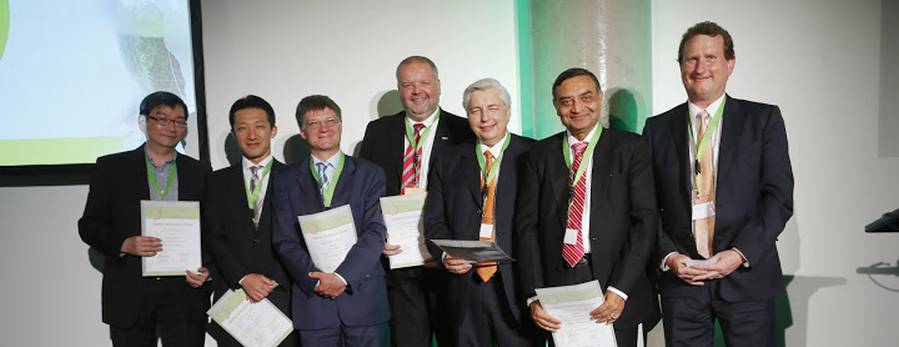
The winners in the different categories are:
- Sung Hing Industries Holding Limited, China (Category Environmental Management)
- Mattes & Ammann GmbH & Co. KG, Germany (Category Social Responsibility)
- Veramtex S.A., Belgium (Category Safety Management)
- YKK Corporation, Japan (Category Quality Management)
- Lenzing AG, Austria (Category Product Innovation)
- Century Rayon (Special Award for Sustainable Efforts)
The Sustainability Award was created in 2012 on the occasion of the 20th anniversary of OEKO-TEX®. By the end of last year, over 80 companies from 22 countries worldwide and from all stages of the textile value chain had applied for the award, which is not endowed with any prize money. The contenders cover the entire range of the textile industry – from a highly specialised finishing operation with only 12 employees, to a fully integrated shirt manufacturer with around 55,000 employees who houses all stages of production under one roof while also managing cotton cultivation and distribution of the products.
Two “OEKO-TEX® Companies of the Month” were selected every month in the period between March 2012 and March 2013 – one company certified according to OEKO-TEX® Standard 100 and one certified according to OEKO-TEX® Standard 1000. A common feature of all these companies is that they proactively meet the ecological and social challenges in their segment, and that they have implemented more sustainability with respect to their products and production conditions in an exemplary way. 15 of these Companies of the Month were then nominated for the Sustainability Award – three companies in each of the five categories. A jury with seven representatives of the OEKO-TEX® Association, of NGOs, industry and research as well as associations and the trade press will select the winners of the award in the individual categories.
The companies in the international textile industry frequently receive negative press: Harmful substances in products, environmental pollution, inhumane working conditions or factory fires. In the framework of the OEKO-TEX® certification, the OEKO-TEX® Association have been working very closely with around 10,000 companies from the entire textile value chain for many years. And they have seen numerous facilities which are the complete opposite to this negative image of the textile and clothing industry.
These companies are characterised by initiative, social responsibility for their employees and the location, best possible product quality, a modern production concept and a high potential for innovation. They proactively set standards for sustainability, supported by a prudent management team and appropriate company philosophies. At the same time, the economic success of these companies illustrates how seemingly expensive investments in efficient and environmentally friendly production technologies, social working conditions, workplace safety, effective quality assurance, employee training and product innovation really do pay off.
On the occasion of its 20th anniversary last year, OEKO-TEX® launched the Sustainability Award to recognise OEKO-TEX® certified companies who have shown outstanding commitment in the area of sustainability. The aim of the award is to draw attention the many exemplary companies who stand out on account of their safe products and sustainable production conditions. They achieve this independently, on the basis of current legislation and regardless of their production location and the respective markets. The applications received for the “Company of the Month” campaign additionally show the wide range of clever ideas and measures employed by these companies to create and successfully implement sustainable conditions in everyday production.
Categories of the Sustainability Award
The OEKO-TEX® Sustainability Award were presented in different categories to provide a clearer picture of the specific achievements and the unique characteristics of each company. What unites all nominated companies, though, is that they are positive examples of sustainability in all relevant company areas.