#Sustainability
Successful sustainable spinning - Gebrüder Otto GmbH & Co. KG is certified according to OEKO-TEX® Standard 100plus
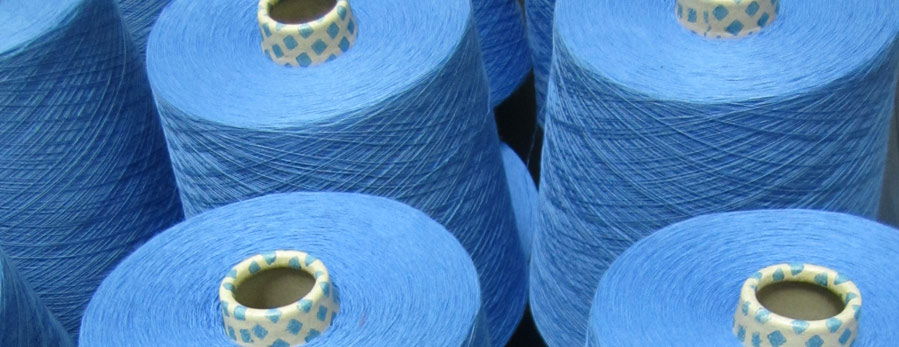
In 2002, the company was certified as an environmentally friendly and socially responsible production facility in line with the requirements of OEKO-TEX® Standard 1000 as the first spinning mill and dye works in Germany. This allows the company to attach the OEKO-TEX® Standard 100plus label to its products as well.
Over 100 years of progress and quality The company started out as Gebr. Otto with a twisting mill in Dietenheim in 1901. The increased demand for textiles following World War II lead to the addition of the sectors dyeing, mercerising and ring spinning. A second spinning mill was added in 1990 despite the general crisis in the German textile industry. Today it is one of the most modern plants in Europe. 160 employees work at the production facilities in Dietenheim and Unterbalzheim, producing yarn for customers in the sectors circular knitting, flat knitting and weaving as well as for manufacturers of technical textiles (e.g. automotive, hygiene) and medical textiles.
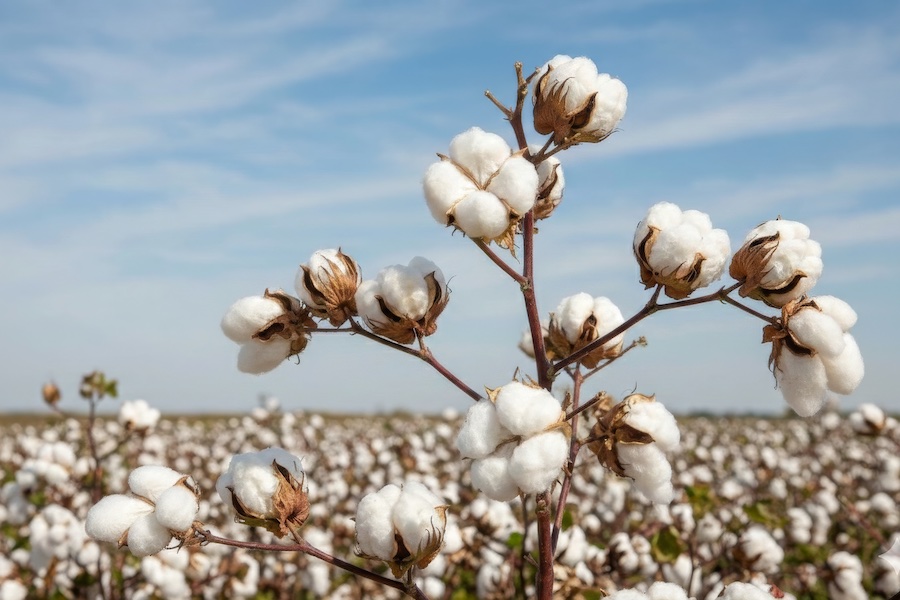
Gebr. Otto focuses on yarns of the highest quality, made from the natural product cotton as well as from fibres from natural raw materials. The company is one of the leading yarn manufacturers, producing an annual output of more than 3000 tons of cotton yarn with modern plants for spinning, twisting, dyeing and yarn mercerising. Customers include renowned clothing manufacturers and brands such as Petit Bateau, Schiesser, Speidel, Mey, eterna, Trigema or Triumph International. This makes Gebr. Otto one of only a few manufacturers in the textile industry who can maintain their position in Germany, thanks to the appropriate know-how and the required experience. ‘We practise our values from generation to generation rather than from one quarterly profit to the next. And that includes a very strong sense of identification with our employees and our location,’ Andreas Merkel, managing director at Gebr. Otto, points out. But this great loyalty to the roots of the company also meant that the company first had to create the preconditions for being able to prevail over the competition from low-wage countries. According to Andreas Merkel, this was ensured by developing an appropriate strategy: ‘From a purely economic point-of-view, production in Germany does not actually pay. This is the reason why we focus on a premium and niche strategy to be able to stand our ground on the international market.’
Sustainable Concepts The core business of Gebr. Otto is essentially based on three pillars: manufacturing of fine premium yarns for the technical sector and the clothing industry (OTTO Premium Yarns), the development and introduction of sustainable, integrated product concepts for customers in the clothing industry and in the technical sector (Sustainable Concepts) and the manufacturing of hygiene products and class 1 medical products (OTTO-Medicare).
The company division ‘Sustainable Concepts’ has been focusing on a now omnipresent trend since 1998. For the spinning mill this was a reaction to the increased ecological demands of the customers – mainly from the clothing industry but also from the sector of technical textiles.
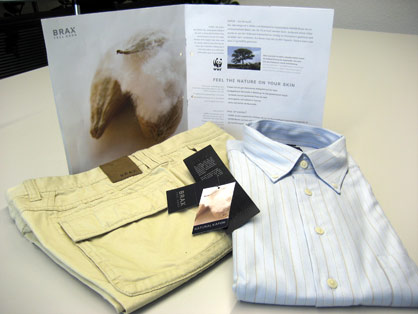
Pic: The natural wax coating of the fibre only allows a low level of moisture absorption – an advantage that promises excellent wearing properties for clothing textiles.
‘Environmental protection and sustainability are not just lip service for us‘, stresses Andreas Merkel, ’they determine our business activities. We have firmly embedded this claim into our company philosophy.’ In addition to the product ranges ‘Fair Trade’ and ‘Bio Yarns’ (where Gebr. Otto is one of only a few spinning mills to offer the combination of Fair Trade and organic cotton), this has lead to the creation of innovative products and concepts which have attracted international attention.
The Piumafil® yarn developed in 2006 allowed the company to use innovative technologies for spinning a mixture of wild kapok and hand-picked cotton into high-quality premium yarn for the first time. Until then the kapok fibre had been thought to be unsuitable for spinning and was primarily used as a filling material. Kapok is a hollow cellulosic fibre with a length of approx. 2-4 cm. It contains 80% air and is six times lighter than cotton. The kapok fibre has special thermal properties and a silky sheen, which is why it is sometimes referred to as silk cotton or vegetable cashmere. The natural wax coating of the fibre only allows a low level of moisture absorption – an advantage that promises excellent wearing properties for clothing textiles. The kapok tree is a tropical plant indigenous to Indonesia, Java, Malaysia, West Africa, the Caribbean and northern South America. Kapok does not grow in monocultures such as plantations. It needs the environment of the tropical rainforest and is therefore free from pesticides and fertilisers. Kapok is 100 per cent biodegradable. Andreas Merkel also focuses on the benefits for the people and the natural environment in the countries of origin: ‘A demand for the fibres from wild kapok trees ensures the livelihood of the local population who harvest these fruit by hand. This in turn prevents deforestation by fire in these areas.’ With this contribution to the protection of the tropical rainforests, the company is an official partner of the nature conservation organisation WWF (World Wide Fund for Nature). Part of the profits from Piumafil® go towards the reforestation of the tropical rainforest.
Another innovative product concept is the recot²® fibre which was developed in cooperation with Ulm university. The name is a combination of the words ‘recycled’ and ‘cotton’. The power of 2 represents the magnitude of the possible savings with regard to water as a natural resource. The new fibre mix consists of 50% raw cotton and 50% recycled selected production waste or 75% organic raw cotton and 25% recycled cotton. This saves water and significantly reduces the use of pesticides. The production of a T-shirt, for example, usually requires about 4,000 litres of water from raw material to finished product. With the new fibre, only half the amount of this precious resource is used. This manufacturing method can save 5,000 litres of water for each kilogramme of yarn. Andreas Merkel sees huge potential for the future: ‘The lack of water is becoming dramatically obvious in more and more regions of the world. With this approach, we have made our contribution to the protection of this valuable and life-sustaining natural resource.’
Sustainable added value In 2002, Gebr. Otto was one of the first ever companies to be certified according to the requirements of OEKO-TEX® Standard 100plus. The OEKO-TEX® Standard 100plus product label enables textile and clothing manufacturers to use one single test mark for providing their customers with documentation of the human ecology requirements according to OEKO-TEX® Standard 100 and their environmentally friendly production conditions according to OEKO-TEX® Standard 1000. Andreas Merkel is convinced that the required measures have been worthwhile for the company: ‘We are convinced that products from environmentally friendly production which have undergone testing for harmful substances offer clear added value for consumers. OEKO-TEX® Standard 100plus is one of the few labels that can communicate this added value for finished textiles at point of sale.’
-418.jpg)