[pageLogInLogOut]
THE BEAUTY OF DETAIL GROZ-BECKERT

#Knitting & Hosiery

Highest standards in the production of standard lace
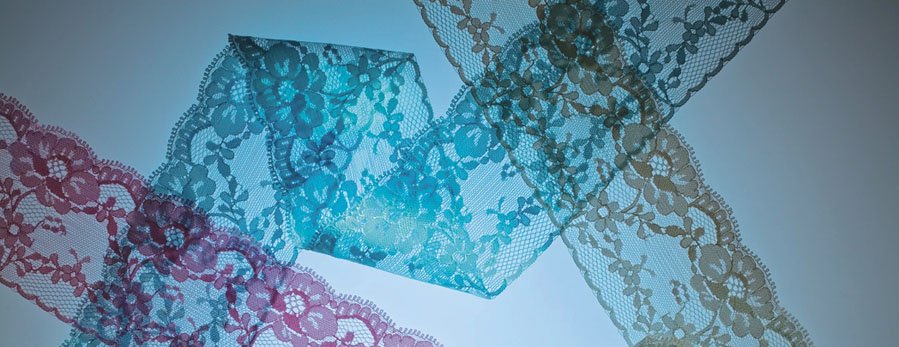
The new generation of the ML machine series upgrades the production of lace.On the one hand, standard lace (Fig. 1) is one of the essential ingredients in the successful repertoires of lingerie and clothing manufacturers. On the other hand, these delicate fabrics are among those textiles that are subject to the rapidly changing trends of the fashion world, which make increasingly stringent demands of the production technology.

Above all, the demand is for the efficient production of even short runs, short changeover times and flexible patterning possibilities – and all this must be achieved for the lowest possible purchasing price.


KARL MAYER has reorganised the set-up of its ML series of machines so that it can optimally support those customers who operate on the fast-moving lace market with its extreme cost constraints. As of the first quarter of 2012, all the electronic Multibar Lace machines (Fig. 2) can be bought from KARL MAYER China, and machine types ML 41, ML 34 and ML 46 will be available. This shift in production should enable the KARL MAYER Group to network all its regional centres of excellence in the best possible way. Whilst the production, quality assurance and development departments at the company’s headquarters, with their many years of know-how and expertise in the manufacture of fully electronic Multibar Lace machines, will always be on hand, the Wujin site will profit from its geographical location close to the market and its advantageous business conditions.

The performance profile of the electronic Multibar Lace machines All the models in the ML machine series are equipped with the KAMCOS® computer platform, electronic guide bar control, and the high-performance, high-precision string bar system for patterning. These features place the Multibar Lace machines at the cutting edge of KARL MAYER’s lace production technology. These three models in the low- and middle-bar sector can cater for the entire production spectrum typical of the mechanically controlled machines in the previous series, but they also offer a number of important advantages. The old type of multibar raschel machines were based on the principles of control by pattern chains or summation drives, and have been an established feature of the market for decades. The latest generation of Multibar Lace machines now enables the users to replace their existing technology with this new technology. Above all, anyone buying the modern ML models will be able to profit from a much higher level of productivity for their investment compared to the mechanically controlled machines. If the speed is considered as a function of the purchasing price, then the potential for optimisation is even higher. Depending on the lapping and the type of yarns used, the speed can be increased to 900 min-1, which represents more than a 100% increase in performance compared to the previous models in the SU series and the chain-controlled machines. What is more, the flexibility of the electronic system for controlling the pattern bars is not restricted in the same way as the mechanical pattern chains and summation drives were, an advantage that is further enhanced by the implementation of the string bar concept with its movement path of more than 180 mm. Lace ribbons having different widths can thus be produced extremely efficiently with the same setting schemes, and this also applied when working small- and medium-sized orders. Furthermore, the modern ML machines can also be operated much more easily than the chain-controlled machines. Time-consuming operations, such as setting, grinding and assembling the chain links are no longer necessary, thanks to the electronic control technology.

And last but not least, these innovative models in the state-of-the-art Multibar Lace machine series offer advantages in terms of environmental protection and sustainability, since the patterning system uses no lubricating oils whatsoever. All in all, investment in the high-performance ML machines is the perfect way of replacing existing machinery.

The different models in the ML seriesThe technical principles of the innovative ML series are based on a single, overall concept, but the various models are differentiated by modifying the bar configuration. Whereas the standard version of the ML 41 has three stitch-forming ground guide bars at the front, there are two on the ML 34 and ML 46. The two rear ground bars are designed to process elastane. The ML 34 is equipped with four pattern bars in each of six shog lines and one shog line with six pattern bars (Fig. 3). The ML 46 has seven shog lines at this point, each with six pattern bars (Fig. 4). Six shog lines each with six pattern bars are used between the ground guide bars at the front and rear on the ML 41 (Fig. 5). All the Multibar Lace models are available in gauges E 18, E 24 and E 28. Whereas the gauge of E 18 would be of particular interest to clothing manufacturers, the finer-gauge Multibar Lace version is setting new standards in the production of traditional stretch and non-stretch lace. By offering a variety of well-thought-out options, the electronically controlled ML models can cover a broad spectrum of applications. For example, the yarn can be fed from a creel or from driven pattern beams with standard dimensions for use on 134"-wide machines. The specific configuration for producing Powernet fabrics, in combination with the gauge of E 28, would be extremely attractive to producers of functional lingerie.

Initial reaction from the market Modern lace raschel machines with their exceptional price: performance ratio for producing standard lace in various batch sizes, which may range from narrow ribbons to wide bands in various dimensions, are already attracting the interest of manufacturers worldwide. The conversations held at ITMA in Barcelona were very promising. Orders have already been taken for the first machines. By offering them the possibility of modernising their machinery, KARL MAYER’s customers will be able to strengthen their position on the market and open up new areas of application.
More News from KARL MAYER Textilmaschinenfabrik GmbH

#Knitting & Hosiery

TM WEFT, 270" – More width, more design freedom for the fashion world

KARL MAYER is expanding its successful TM WEFT series with an innovative model that opens up new possibilities, particularly in the fashion & apparel sectors. With a working width of 270", this new machine with weft-insertion not only offers significantly higher output than its narrower counterparts but is also specifically tailored to the demands of dynamic clothing market – particularly in China and Türkiye. A well-thought-out upgrade also ensures even greater design versatility.

#ITM 2026

KARL MAYER strengthens customer partnerships in Türkiye

Türkiye has been one of KARL MAYER’s most important markets for decades. The first KARL MAYER warp knitting machine was delivered to Bursa as early as 1951. It was installed by Karl Mayer himself and marked the beginning of a long and successful partnership.

#ITM 2026

ITM 2026: KARL MAYER presents new perspectives

KARL MAYER will once again showcase itself as a strong partner to the Turkish textile industry at ITM in Istanbul from June 9 to 13. At Booth 303 A in Hall 3 of the Tüyap Fair Convention and Congress Center, the industry leader will exhibit solutions for warp knitting, warp preparation, and technical textiles – tailored to a challenging economic environment.

#Techtextil 2026

Techtextil 2026: KARL MAYER impresses as an innovative sector partner

KARL MAYER looks back with satisfaction on its participation in Techtextil 2026. From April 21 to 24, the international industry leader used the trade show in Frankfurt to meet with numerous key customers at its booth and, at the same time, establish many new contacts. Most visitors came from Germany, followed by major markets such as Poland, the United Kingdom, Turkey, France, and Portugal.

More News on Knitting & Hosiery

#Knitting & Hosiery

“We need to move away from the price trap and return to a value-driven mindset.”

With its new Textile Innovation Center, KARL MAYER is sending a strong signal for innovation, collaboration, and the future of textile applications. In this interview, Karl Josef Mayer discusses new opportunities in warp knitting, the processing of staple fibres, recycling, the changing role of machinery manufacturers, and why the textile industry must once again focus more strongly on the value of textiles. by Oliver Schmidt

#ITM 2026

SHIMA SEIKI to show complete knitting and cutting workflow at ITM 2026

Leading computerized flat knitting technology provider SHIMA SEIKI MFG., LTD. of Wakayama, Japan, together with its Turkish representative TETAS IC VE DIS TICARET A.S., will participate in the ITM 2026 International Textile Machinery Exhibition in Istanbul, Türkiye this month with a full product lineup. In addition to flat knitting machines and design software, visitors will also have the opportunity to experience the full range of SHIMA SEIKI textile machinery with its automatic cutting machine exhibit, all geared toward the fashion apparel market as well as non-apparel related businesses.

#ITM 2026

Mayer & Cie. Global is getting ready for ITM 2026

ITM 2026 marks the beginning of a new chapter for Mayer & Cie. Global. For the first time, the company will present itself to the international textile machinery industry in its new setup: combining proven circular knitting technology engineered in Germany with a clear commitment to its Albstadt headquarters and an internationally shaped, agile management approach.

Latest News

#HIGHTEX 2026

The heart of the technical textiles and nonwovens world will beat in Istanbul

Only 1 day remains until HIGHTEX 2026 International Technical Textiles and Nonwovens Exhibition opens its doors. Bringing together manufacturers, technology developers, investors, and industry professionals from around the world, HIGHTEX 2026 is preparing to showcase the innovations shaping the future of the industry. As the countdown to this major event continues, Istanbul is once again getting ready to become the meeting point of the global technical textiles industry.

#Man-Made Fibers

Grasim Industries announces fresh investment of ₹3094 Crore to expand Lyocell capacity

Grasim Industries Limited, the flagship company of the Aditya Birla Group and a global leader in cellulosic fibres, today announced an investment of ₹3,094 crore, for Phase II Lyocell capacity of 110K TPA at Harihar, Karnataka. This expansion will consist of 2 lines of 55K TPA (150 Tons per day) each. The first line is expected to be commissioned by 2028, and the second line is expected to be commissioned by 2030.

#ITM 2026

The future of textiles, the power of trade, and the summit of technology come together at ITM 2026

ITM 2026 International Textile Machinery Exhibition, one of the most prestigious organizations in the textile technologies sector, opens its doors to visitors between June 9-13. Expected to break records in terms of both exhibitor and visitor numbers, as well as the technological vision it presents, ITM 2026 will transform into a global trade hub with machine sales, and new business collaborations.

#Nonwoven machines

ATCO Hygienics, Uzbekistan, orders baby diaper production line from ANDRITZ

International technology group ANDRITZ has received an order from ATCO Hygienics to supply a new baby diaper production line for its plant in Tashkent, Uzbekistan. The order is included in ANDRITZ’s order intake for the first quarter of 2026. Commissioning of the production line is scheduled for the end of 2026.

TOP