#Textiles & Apparel / Garment
New product label – Tested quality ‘Skin flora neutral’
They can also not be increasingly released through sweating or washing. The researchers were able to give the basic all clear for the products examined. However, they also suggested studying the effects of these functionalised textiles on the skin flora in the context of consumer protection.
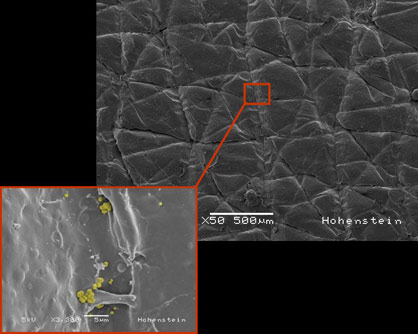
The Hohenstein researchers have now tackled this problem. A new test system allows tex-tile manufacturers to have the effects of antibacterial finishes on the skin flora examined already during product development. The practicability and reliability of the results pro-duced by the test system have already been proven through examination and comparison of functional textiles with antibacterial finish.
The practically oriented test is based on a standardised model of the human skin flora which simulates the germ population, topography and environmental properties of healthy skin. To achieve this, several germ types were selected from the micro flora of a human epidermis and applied to a specially developed artificial skin replacement material (HUM-skin). The effect of the test material on these germs is quantified during a wearing simula-tion over a period of 18 hours and then evaluated against a control material without antim-icrobial finish. This process examines the change in the total number of germs as well as the number of individual germs. If no significant reduction in the number of germs occurs within the exposure time, the textile is considered to be ‘safe’ with regard to the body's own skin flora.
The test results can be advertised using the Hohenstein Quality Label ‘Antibacterial & Skin flora neutral’. Successful testing for antibacterial effectiveness according to DIN EN ISO 20743 is a prerequisite for obtaining the label. To ensure realistic testing, the test system was correlated with textiles from an earlier field study concerning the influence of antibac-terial clothing (AiF no. 15537 N).
The aim of the Hohenstein Quality Label ‘Skin flora neutral’ is to allow customers to see which antibacterial textiles have been proven to have no influence on the skin flora. In addi-tion to the current tests ‘Antibacterial’, ‘Odour reduction’, ‘Effective against dust mites’, ‘Skin friendly’ and ‘Suitable for allergy sufferers’, the Hohenstein Institute can now offer another certification for textile manufacturers which is directed at retail customers.
Prof. Dr. Dirk Höfer explains, ‘The new product label ‘Skin flora neutral’ is the ideal supple-ment to the Hohenstein Quality Label we introduced a few years ago.’ The newly developed test system can also be used to examine the impact of antibacterial cosmetics and deter-gents.
Skin flora
With a surface of around two square meters, the skin is the largest organ in our bodies. It is densely populated by microorganisms such as staphylococci, micrococci, propionibacteria and corynebacteria. These make up the so-called resident skin flora which plays an important role in the skin's barrier function and protects us against outside influences and pathogens.