#Techtextil / Texprocess 2013
Techtextil: Technical textiles from nature
Fibre products based on proteins, fungi and bacteria Textiles would have not only a natural origin but also other qualities such as anti-bacterial properties, high-strength or be particularly good at absorbing moisture. These provide the basis for a variety of potential application areas: from automotive and apparel to medical equipment, packaging technology and cosmetics. One such example is Qmilch, a new fibre material based on casein protein that has numerous advantages compared to conventional raw materials for textiles. An environmentally friendly manufacturing process is used to produce milk protein fibres without any chemical additives. The fibres contain up to 18 amino acids that support cell growth and so prevent skin ageing. Milk protein fibres promote blood circulation, reduce itching skin and have a smoothing function. Furthermore the way these functional fibres control moisture is 99 percent successful in preventing the growth of bacteria. It also facilitates temperature regulation which is important for allergy sufferers. Production of the fibres does not use milk that would be suitable as a foodstuff. In fact it uses colostrum from cows that are just calving or the centrifugal waste material from cheese production. Companies dispose annually of 1.9 million litres of non-saleable milk. Based on the qualities previously mentioned milk protein fibres are suitable for use primarily in the automotive industry and for medical equipment where they offer benefits for heat insulating seat covers or hygienic membranes. Even small amounts of milk protein fibres added to textiles can produce positive effects. “Incorporating only around 20 percent is more than sufficient to make the surface anti-bacterial”, says Qmilch founder Anke Domaske. Until now the fibre material has been produced on a pilot line. It is planned to scale up production in the middle of 2013. Another example of an innovative, new bio-based fibre material comes from bionics research and takes inspiration from spiders. The fibres and webs naturally produced by spiders are uniquely stable and elastic at the same time. Relative to its extremely fine structure, spider silk is strong as steel and elastic like rubber. For years scientists have tried to solve the riddle of spider silk and recreate it industrially.
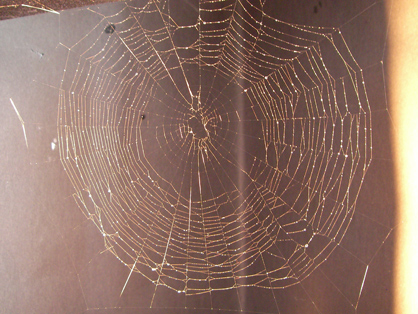
Pic: Net of a spider as the inspiration for the spider silk fibres
Now AMSilk AG and Professor Thomas Scheibel from the University of Bayreuth have succeeded in doing just that. Based on a traditional fermentation process and using genetically manipulated bacteria it is possible for the first time to produce any quantity of spider silk proteins for a wide range of applications. Although research is still ongoing into the industrial production of threads using spider silk proteins, the manufacture of raw material in ball, membrane, film and foil form is already possible.
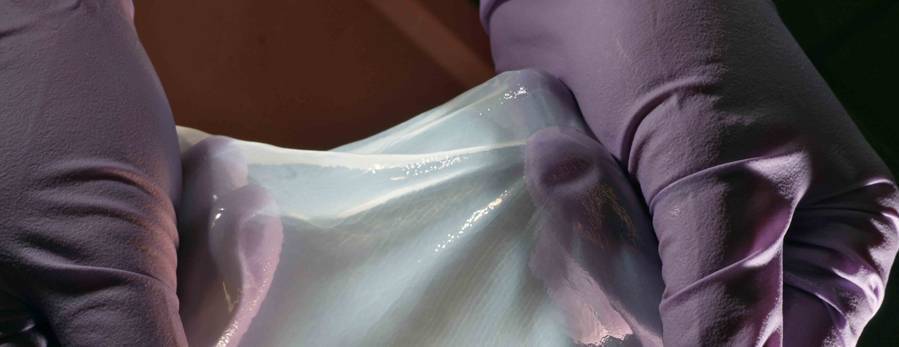
For example it is possible to produce a spider silk film and / or spider silk foil by means of a diluted silk solution. This innovative production technology makes it possible to adapt and control the form of silk proteins as required and opens up use of the first silk products in industry and technology.
Human tolerance to spider silk proteins is very good making it conceivable to use them for cosmetics, medical implants and suture material. At the Hannover Medical School (MHH) investigations are also being carried out into using the silk from the golden orb-weaver spiders of Tanzania to grow artificial skin. In this programme AMSilk is using 24-well cell culture plates that selectively have been given a thin silk coating or contain an open pore foam matrix of spider silk. In addition limited numbers of 24-well plates are available with inserts made from spider silk non-wovens. Since February 2013 AMSilk has been offering all research kits with a research licence included. Professor Thomas Scheibel explains: “The technology platform we have developed is the first time in the world it has been possible to establish products on the basis of spider silk proteins. It is conceivable that it will not be long before you find bio-tech spider silk products on the market.”
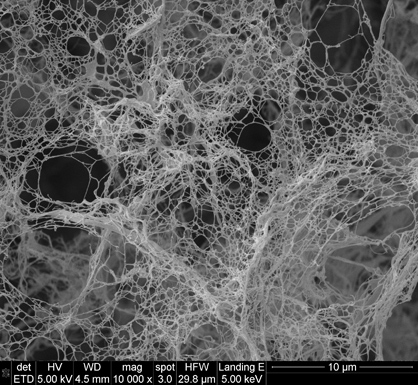
Pic: Dried nanocellulose powder was developed at the EM
The Techtextil trade fair presents innovative, sustainable solutions for a variety of application fields There are also new developments in what are known as cellulose fibres. The exceptional properties of these fibres are based on biological processes that have not previously existed in this form. The cellulose fibres are almost exclusively of vegetable origin. An alternative bio-based manufacturing concept uses microbes to transform glucose into cellulose as part of a fermentation process. This results in nano-scale fibre material with properties that are clearly different from those of its vegetable origin. Nanocellulose fibres have a diameter of less than 100 nanometres and a length of a few micrometres. The individual fibres are very strong relative to their mass and crosslink to form strong webs. As a result they have a very large surface area which makes them extremely reactive. Nanocellulose uses inorganic, organic and polymer materials to form physicochemical compounds. This makes it extremely interesting for the automotive industry as a reinforcement material for the manufacture of high strength polymer compounds with similar strength properties to those of metallic components. Nanocellulose can also be used to improve the mechanical quality of wood and cardboard materials. As nano-porous bio-foams they can replace conventional insulation materials. When pressed to form a dense paper a nano-fibre network incorporating dispersed clay particles can be used in composite packaging as a barrier layer for oxygen or water vapour. It replaces the aluminium that is presently used. Nanocellulose is also interesting as a membrane and filter material in medical technology. “Bacterially synthesised nanocellulose is a high performance high-tech bio-polymer with unique material properties whose structure and form can be controlled during the process of biosynthesis enabling it to be used for innovative and forward-looking solutions for medical applications , e.g. as a modern wound dressing,” explains Dr. Dana Kralisch from JeNaCell GmbH. At the Institute of Technical Chemistry and Environmental Chemistry of the Friedrich Schiller University in Jena with the cooperation of partners EPC Engineering Consulting GmbH and Polymet e.V. it has been possible for the first time to produce nanocellulose under constant process conditions on a small scale pilot line. JeNaCell GmbH is spinning this off into larger scale production. A process for manufacturing dried nanocellulose powder was developed at the EMPA, Swiss Federal Laboratories for Materials Science and Technology.