#Techtextil / Texprocess 2013
Techtextil: Highly sensitive textile aids
Techtextil exhibitors present innovations in the field of pressure and heat sensors
As is often the case, these discoveries subsequently become part of everyday and leisure apparel and so benefit a wider group of users. These textile sensors can also provide assistance to people who, due to illness or accident, have lost their own sensory capacity. Techtextil takes place between 11 and 13 June 2013 in Frankfurt and will feature the latest developments in the wide range of applications for textile sensors.
The path now followed by sensor research can be seen basically as a counter-concept to so-called ‘wearable electronics’. Whereas the latter integrated electronic components into clothing for communication or entertainment purposes in a way that was as compatible with textiles as possible, the approach taken in the sensor sector is quite literally more sensitive. In this area it is state of the art to incorporate conductive fibres and/or polymers into clothing for measurement purposes. It is possible to measure a myriad of different data and relay them either to external stations for measurement / analysis or to recording devices worn on the body.
Next there are pressure sensors. The company Alpha-Fit has developed a sock that incorporates threads which are both conductive and capable of measurement at crossover points to create a diagnostic tool that is used to fit orthopaedic shoes for people with diabetes. In contrast to previous development models, it is possible to capture the pressure distribution in 3D and show the relative dynamic pressures that act on the whole foot when walking. Using these precise data the orthopaedic shoemaker is able to make shoes that have the necessary width and support at the critical points to help prevent the effects of diabetic foot.
What has been initiated by Alpha-Fit in the field of medical technology can also be applied to other applications. Ski shoe fitting could be one such application, for example. Downhill skiers will know the ‘pain’ feet are obliged to endure following several hours of sport. Further areas of application include pressure mats to measure pressure distribution when someone lies on a mattress. In this case ‘good sleep’ textile sensors react to the hardness or softness of the underlayer. Bicycle saddles and wheelchairs are other conceivable application areas for short term implementation.
The sock example demonstrates not only the wide range of potential applications, but also how important interdisciplinary cooperation is in this industry. Partners in this development included, for example, the company Novanex from Leipzig who helped Alpha-Fit in terms of design, production development, research and marketing. The companies are currently working together on body mapping solutions that illustrate the distribution of pressures on the body as it moves during high-performance sports so as to potentially provide new insights for the design of supportive clothing.
At the Institute of Textile Technology and Process Engineering (ITV) in Denkendorf two research projects supported by the German Federal Ministry for Education and Research involve quite different sensors. The lead project is called ‘SensProCloth’ and is concerned with the issue of ‘system-integrated sensory protective apparel for the fire service and incident response units’, while the second, related project is termed ‘iBePol’ and is derived from the first as ‘intelligent operational apparel for police and security forces. The overall goals of both projects are to use system-integrated protective apparel to continuously capture and relay information about vital and status parameters, activities, ambient conditions and events in addition to providing emergency services’ communication and data transfer for the fire service and incident response units. Furthermore the sensors should help determine the location of the emergency services in buildings or out in the field and in an emergency enable medical assessment of a condition by the emergency services so that assistance can be provided in time. In addition the communication and monitoring system should help the mobile operational control take decisions.
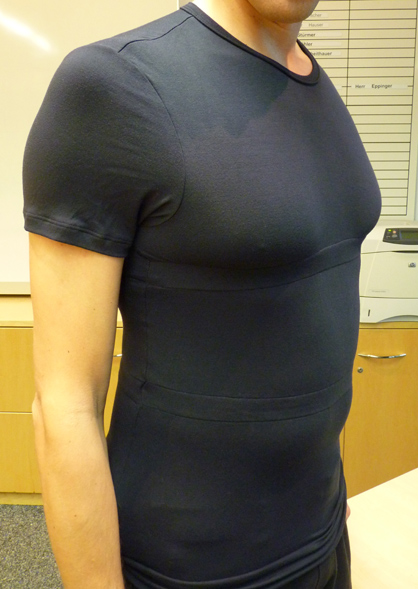
All the sensors to capture the vital parameters are contained in a t-shirt that is worn against the skin. The vital parameters collected include hear-rate / ECG, breathing rate, body temperature and activity level. Ambient temperature on the outside of the clothing is measured to determine the environmental parameters and optical harmful gas sensors are used. These optical signal devices are also located on the outside of the clothing. The risk status is signalled by a three colour LED traffic light and a buzzer. When the completed protective apparel was subjected to the Thermo-Man test, involving eight second exposure to fire at 1,000 degrees Celsius, there was no impairment of any kind to the protective function of the sensor system. After the test all the sensors and LEDs worked perfectly. In a flashover container it was shown that the sensors also measured temperatures over 250 degrees Celsius. Consistent heart rate measurement was possible and evaluation of the subsequent ECG curves showed that the quality of the data was high. Even the steel skin of the container did not impair communication. The ‘iBePol’ project builds on these developments and is intended for use in apparel systems for both civilian and protective use. It is also intended to integrate sensors for hazardous substances.
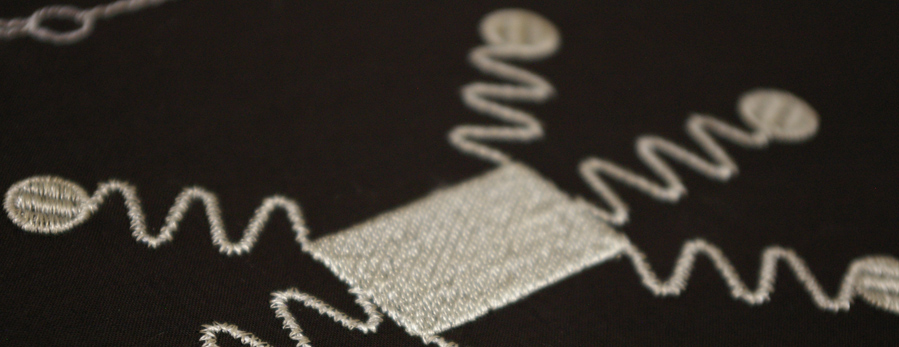
The Swiss company Forster Rohner is using an age old textile technology; its Textile Innovations division is working with development partners to create highly innovative textiles on ultra-modern, high-tech embroidery machines. They develop and produce functional textiles for their clients based on embroidery technology. Examples are the production of textile-based sensory surfaces, heating elements or antennae structures in addition to the incorporation of LEDs and solar cells. These products are mostly the result of cooperative development and are to a large extent subject to confidentiality; anyone interested is advised to contact the company directly. Techtextil offers the best opportunity to do this. Ultimately all innovations and research projects are presented live for you to see and experience at Techtextil from 11 to 13 June and at the Texprocess trade fair that is being held in parallel.